
To remember a list in order, place one striking image at each fixed stop, then recall the items by following the same route.
Memory palace: Build Your First Route
Build a memory palace with five familiar stops, vivid word pictures and a written check that shows whether you remember the list in order.
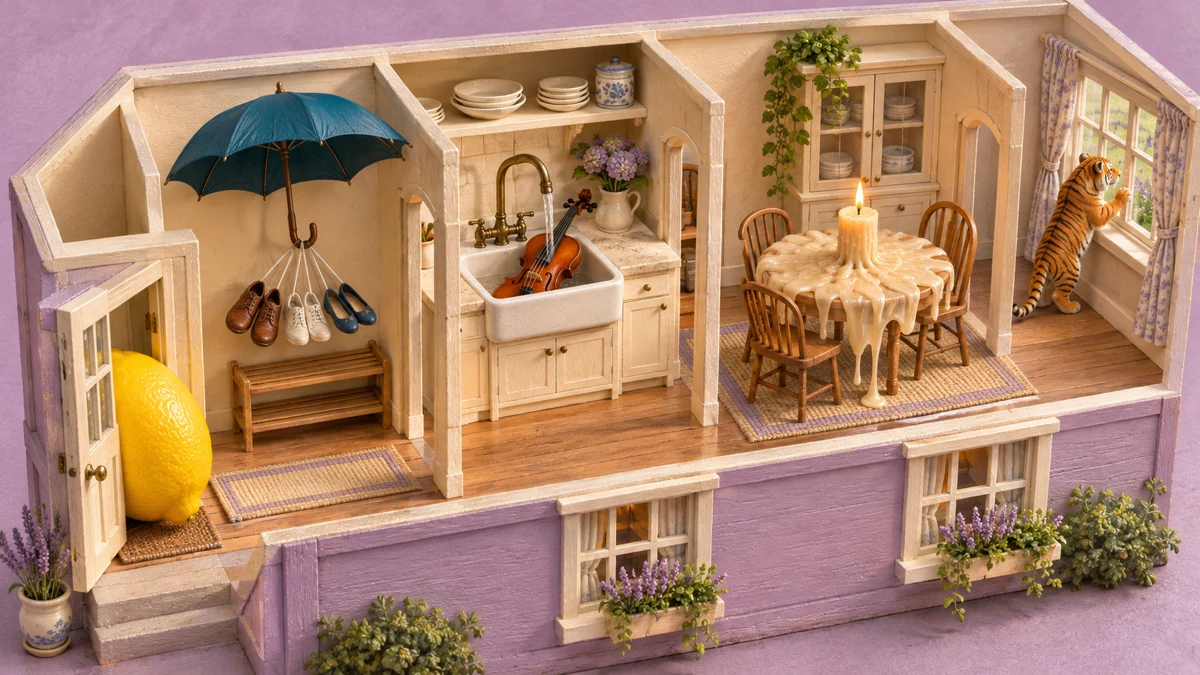
A list can feel familiar while its order slips away as soon as the page is covered. A memory palace gives each item a place on a route through somewhere you already know, such as your home.
To remember a list in order, place one striking image at each fixed stop, then recall the items by following the same route.
For this worked example, the route runs from the front door to the shoe rack, kitchen sink, dining table and window. Use those stops only if their order fits your home. Otherwise, choose places that follow a natural walk through yours.
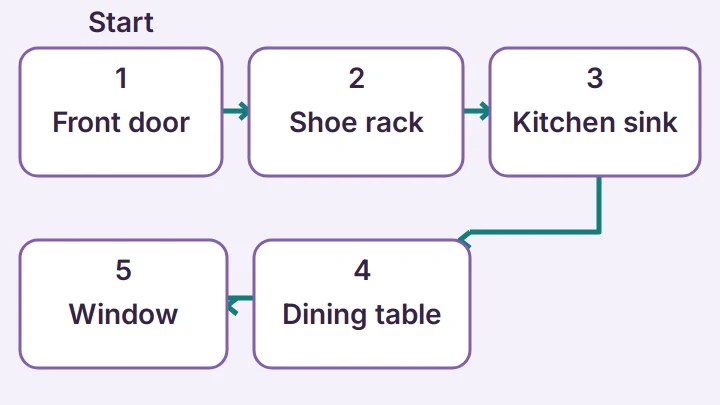
Give each word an exact stop. The kitchen leaves several possible places to search, while the kitchen sink gives the image a specific home. Walk through the empty route in your mind before adding any words. If two stops feel interchangeable, replace one now. Keep the route moving forward rather than crossing back through the same space.
At each stop, make the word do something to that place. A lemon somewhere near the door is easy to leave vague. A giant lemon wedged under the door gives both objects a role: the door scrapes its peel whenever it opens. The image carries the word, and the door carries its position.
| Stop | Word | Picture |
|---|---|---|
| 🚪 Front door | Lemon | Lemon jams the door |
| 👟 Shoe rack | Umbrella | Umbrella lifts the shoes |
| 🚰 Sink | Violin | Violin plays under the tap |
| 🍽️ Table | Candle | Wax coats the tabletop |
| 🪟 Window | Tiger | Tiger presses the glass |
This way of placing images is called the method of loci, meaning a method based on places. A review of 13 randomized trials, mostly in university settings, found that people using it performed better on memory tasks than comparison groups (Twomey & Kroneisen, 2021). For a student learning a list, that supports trying a familiar route as a memory aid. The covered-list check below tests whether your own pictures bring back the words in order.
Take the walk with the list covered
The route supplies the order. Give each picture a moment before moving to the next stop. The pictures can stay separate. There is no need to invent a story explaining why a violin follows an umbrella, because the walk already connects their positions. Finishing the first image before moving on also gives you a clear point from which to begin the mental walk.
That separation tells you what to repair. A missing word sends you back to its picture. A word in the wrong position sends you back to the route: check whether you skipped a stop or moved an image to another location. If two words have traded places, check both locations against the original list before practising again.
The blank in the example below points to a single stop. Return there and make the object act on the location, so the picture has a specific action to recover. Change that one picture, then cover the list and try the route again from the door. Keep the other stops fixed during this repair so you can check whether the change helped.
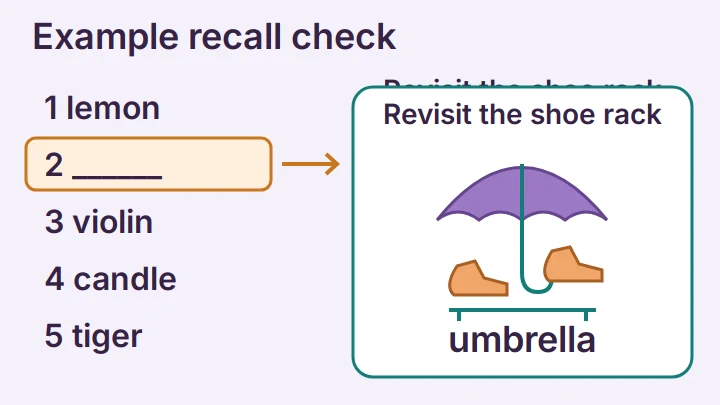
When a picture comes back without its word
Each picture needs a clear meaning. The candle in the example stands for candle. For schoolwork, an image may stand for a term that cannot be pictured directly. That adds a decoding step, so check that the image brings back the exact term before putting it on your route.
For evaporation, water rising from a warm puddle gives the picture something to show. Add the meaning aloud: liquid changes into gas.
Remember this
During recall, say the term and its meaning. Remembering only a picture of a puddle leaves the schoolwork unfinished. Place the scene at one of your exact stops so the route can bring you back to it.
For a class presentation, the stops can hold the points you must cover in sequence. Give each point its own stop and choose an image that brings back its keyword. Then practise explaining that point in your own words as you reach the location. If the task requires exact wording, check that wording against the source after the walk.
Give the next list a clear home
Check order separately from recognition. Cleverini’s Word List shows a set of words, then asks players to select them from a larger grid containing new words. It offers another set of words to practise placing along a route. Before selecting from the grid, recall the route and write its words in sequence.
 Word List
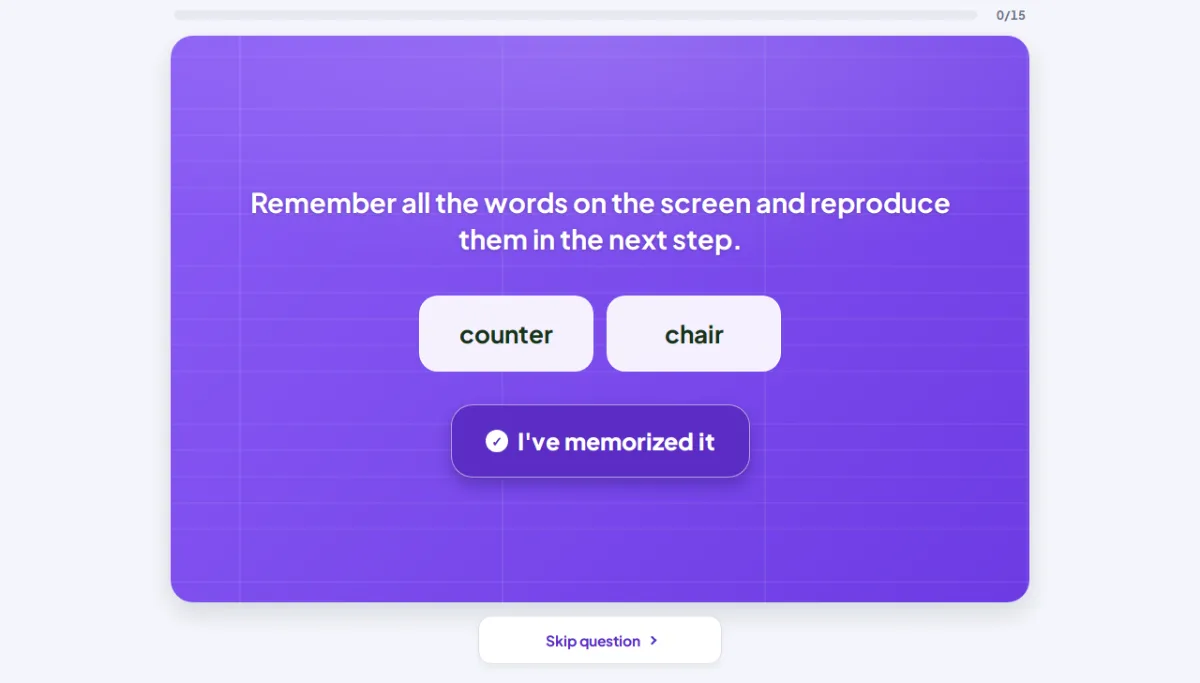 Use the study screen to place the words before they disappear.
The selection grid gives no record of which word you recalled first. Keep your written sequence beside the original list and compare one position at a time. Finding every target in the grid can still leave a gap in that sequence. Treat a blank as a stop to revisit, even when the game accepts all your selections.
When keeping several lists for study, assign each a separate familiar route and write down which route holds which topic. The Memory Practitioner Guide offers further reading. For a new practice list, keep the stops fixed and change the pictures. If an older image returns, move the new list to another route so each stop has one intended answer.
Sources
- (Twomey & Kroneisen, 2021). Conal Twomey, Meike Kroneisen. (2021). The effectiveness of the loci method as a mnemonic device: Meta-analysis. Quarterly Journal of Experimental Psychology. Source.

More from the blog
How to Remember Where You Put Things (Keys Too)
Learn how to remember where you put things with exact location cues, a search from your last confirmed use, and a fixed home for everyday items.
Memory Card Game Rules and 4 Tips to Find Pairs
Learn memory card game rules, four tips for finding pairs, and simple house rules for playing alone or with family.

