
Test tomorrow and your notes still feel unfamiliar—could recall, practice questions, and spaced reviews help guide your next study session?
How to Memorize Fast: 5 Methods That Work for Exams
Learn how to memorize fast with five study habits: recall, practice questions, word retrieval, spaced reviews, and a later self-test.

Your test is tomorrow, and your notes cover the desk. You read a page, turn it over, and struggle to name its main points. That gap is where this study plan starts.
If you're asking how to memorize fast, start with practice testing and spaced practice. A broad review rated both highly across varied learning settings (Dunlosky et al., 2013).
The five habits below turn those methods into a study routine. They fit school topics and work exams, though the evidence comes from specific learning tasks. Each science check explains how far its findings reach.
Five habits for how to memorize fast before your next test
Suppose one page explains how rain forms. Your first answer might name only two steps. Once you check the page, you have a clear gap to work on.
A rough answer can still show what is missing. In this example, “water goes up” might leave out the term your class uses. Comparing it with the notes reveals that difference.
For your own topic, try a closed-notes answer before checking the page. The study supports recall practice; this rain example simply shows how to apply it (Roediger & Karpicke, 2006).
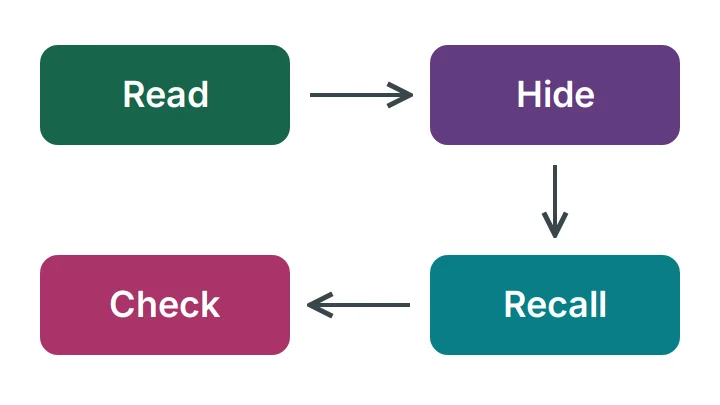
The rain topic now becomes a question: “What are the steps, and what happens at each one?” A heading alone leaves the expected answer unclear.
Here are sample prompts for different kinds of test content. They are ways to set up practice testing, rather than a tested formula for writing exam questions (Dunlosky et al., 2013).
| Test content | Sample prompt | What the answer needs |
|---|---|---|
| A term | What does it mean? | The meaning |
| A process | What happens at each step? | Steps and their order |
| Two concepts | How do they differ? | A clear difference |
Check the missing parts after each answer. For example, a process answer may name every step yet leave out what happens during one (Dunlosky et al., 2013).
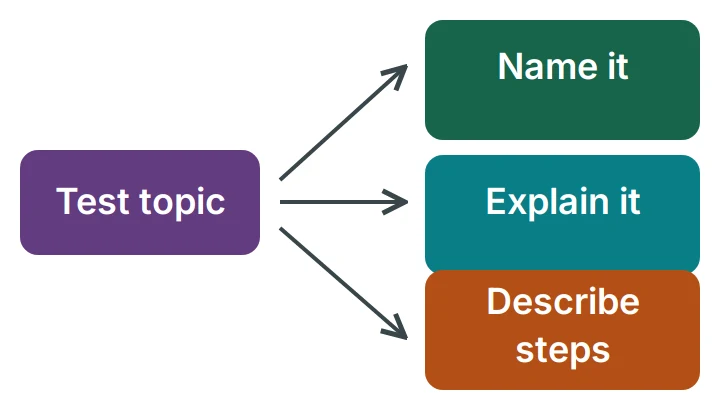
So far, your questions have asked for facts and steps. A language test adds another demand: producing the right word from a cue. The study above used Spanish word-picture pairs.
For language study, try to recall each word from a meaning or picture before looking. That follows the tested retrieval approach (Barcroft, 2007).
An optional game uses a different format. Word Memory shows five words with translations, then asks ten multiple-choice questions. The questions run in both translation directions; the answers are shown as choices.
 Word Memory
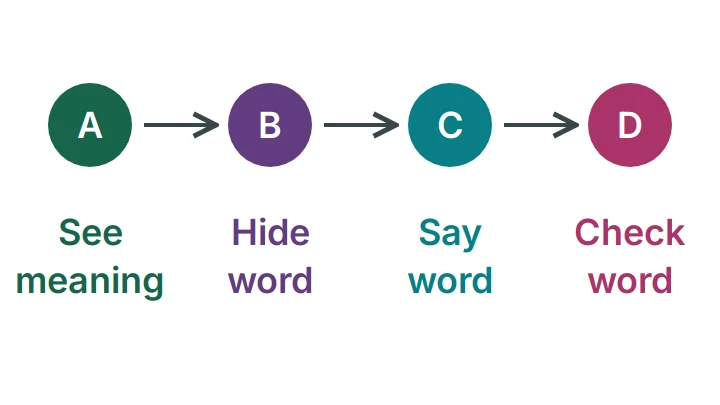
With questions ready, the next choice is when to return. If the test is days away, tomorrow could be another review. If it is tomorrow, a later session today is one way to separate practice (Dunlosky et al., 2013).
Those are planning examples. The supplied studies establish no single best gap for every learner or topic.
The timing of a test also matters when judging a method. In the prose experiment from habit one, restudy did better immediately. After one week, mean recall was 42% after restudy and 56% after recall practice (Roediger & Karpicke, 2006).
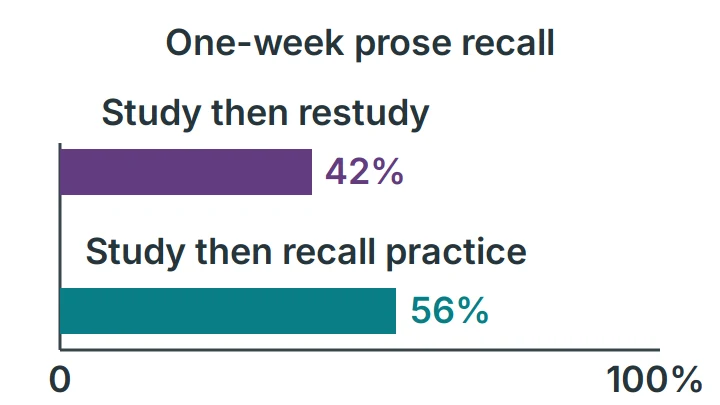
The chart measures recalled prose idea units among university students. Its percentages describe retention in that experiment, rather than exam grades or Cleverini game results.
Your next session now has a starting point: the questions from earlier. Try them with the answers hidden, then check what you missed. Returning to the set applies spaced retrieval, although these studies set no ideal time for each item (Alakbarova & Ball, 2023).
A separate game, Word List, hides a studied list, then asks you to select its words from a larger grid. The grid includes new words. This is recognition with visible options.
 Word List
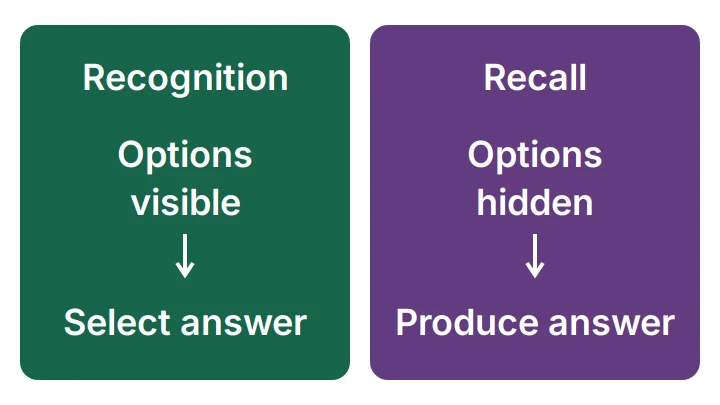
Both games offer their own word tasks. The cited studies establish no exam gains from playing them. The Cleverini research page provides site context; the papers below support this article's study advice.
Quick tip · Remember this
Quick tip: Try before you peek, then check your answer. This keeps a practice question tied to an actual recall attempt (Dunlosky et al., 2013).
Questions before your test
- How can I memorize fast the night before a test? Read one test topic, close your notes, recall, and check. Plan another brief review if time allows (Dunlosky et al., 2013).
- How can I memorize faster and not forget? Use recall practice and return in separate sessions. These methods support retention, while some forgetting can still occur (Dunlosky et al., 2013).
- How should I choose practice questions for an exam? Use the stated test topics to make prompts about facts, meanings, or steps. This is a practical way to apply practice testing (Dunlosky et al., 2013).
- How can I memorize words for a language test? Cover the new word and try it from a meaning or picture cue. Uncover it and check your answer (Barcroft, 2007).
- Do memory games prove I am ready for an exam? A game score reflects its own task. For exam practice, answer questions about your test material with notes closed (Dunlosky et al., 2013).
Sources
-
(Roediger & Karpicke, 2006). Henry L. Roediger, Jeffrey D. Karpicke. (2006). Test-Enhanced Learning. Psychological Science. Source.
-
(Dunlosky et al., 2013). John Dunlosky, Katherine A. Rawson, Elizabeth J. Marsh, Mitchell J. Nathan, Daniel T. Willingham. (2013). Improving Students’ Learning With Effective Learning Techniques. Psychological Science in the Public Interest. Source.
-
(Barcroft, 2007). Joe Barcroft. (2007). Effects of Opportunities for Word Retrieval During Second Language Vocabulary Learning. Language Learning. Source.
-
(Nakata & Elgort, 2021). Tatsuya Nakata, Irina Elgort. (2021). Effects of spacing on contextual vocabulary learning: Spacing facilitates the acquisition of explicit, but not tacit, vocabulary knowledge. Second Language Research. Source.
-
(Alakbarova & Ball, 2023). Durna Alakbarova, Hunter Ball. (2023). Spaced Retrieval Improves Retention and Transfer of Foreign Vocabulary. Center for Open Science. Source.

More from the blog

Memory Games for Seniors: Free, Simple, No Download
Explore free memory games for seniors, with simple ways to play together, offer hints, and keep expectations grounded in evidence.

How to Improve Memory: 6 Habits Backed by Research
Learn how to improve memory with recall practice, checking, and spaced reviews. Try six practical habits and a simple routine for today.

