
Lost your place after another interruption—could five practical habits help you choose a starting action, limit distractions, and find your way back?
How to Improve Concentration: A Simple Daily Routine
Learn how to improve concentration with five practical habits for fewer interruptions, clearer task returns, and brief pauses, with evidence explained.

Learning how to improve concentration can start with a small, familiar moment. You settle down to read. A message flashes, someone calls from the next room, and you lose your place.
The interruption may be a message you can leave or a person who needs an answer. Your task is still waiting when you turn back. The hard part may be finding where to begin again.
You might remember the topic but lose the question you were trying to answer. A whole assignment can feel large at that point. The next line you meant to read is a smaller place to begin.
Think of a quiet harbor with three signal buoys: the task, its next step, and a pause. This is a picture for planning your work. The five habits below turn that picture into choices you can test.
How to improve concentration: five habits for interrupted work
“Do my assignment” leaves several choices open. “Read the first section and mark its main point” names something you can see yourself doing. At work, that might become “draft the opening lines of the report.”
The choice matters most when the time ahead is short. As a planning trial, choose a piece that fits before your next fixed demand. The study did not test this exact way of starting.
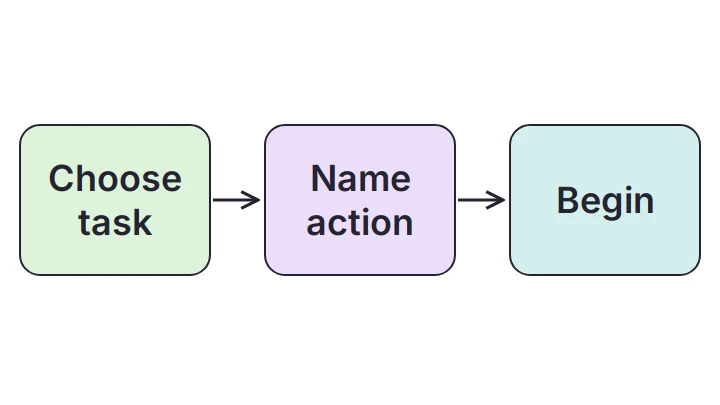
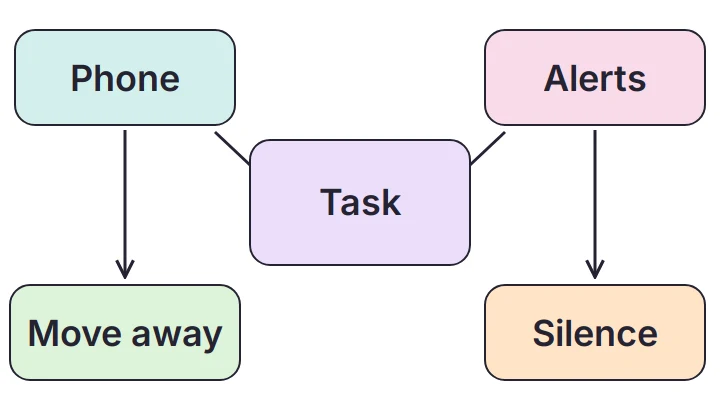
The page is open, and you have a first action. Your phone might now stay in a bag while you read or on a shelf while you write. These are ways to try the change in your setting.
If you need the phone for family contact, that need shapes the choice. A shared room may also stay noisy. You can test a workable phone change there and judge the result for yourself.
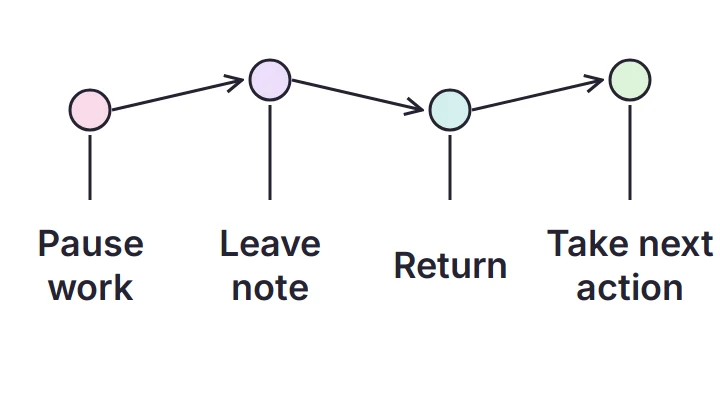
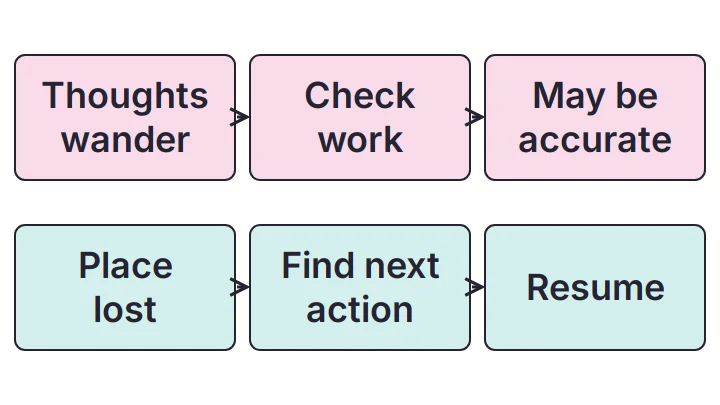
Some interruptions are worth answering. A class ends, a meeting begins, or someone needs help while your work is open. A return note makes the intended next action visible when you come back.
For that note, try replacing a broad reminder with a clear action. These examples illustrate the routine, whose benefit the study did not test. (Leroy, 2009)
| Broad reminder | Possible return note |
|---|---|
| Finish reading | Find the reason in paragraph three |
| Reply later | Add the delivery date to the reply |
| Keep writing | Draft the report's opening sentence |
An abrupt interruption may leave no time for a note. In that case, try using the last completed part to choose your next action. This is another planning option based on the same finding.
Imagine returning to a half-written reply after helping someone at home. “Add the delivery date” tells you where the reply stood. It also leaves the rest of the message for later decisions.
Back at the page, you may find yourself reading the same line again. For your trial, a pause could mean looking away or standing briefly. The studies did not compare those exact choices.
There is no perfect timer setting in these sources. They also do not settle whether you should stop when the work feels smooth. That leaves room to choose a pause that fits the task and your setting.
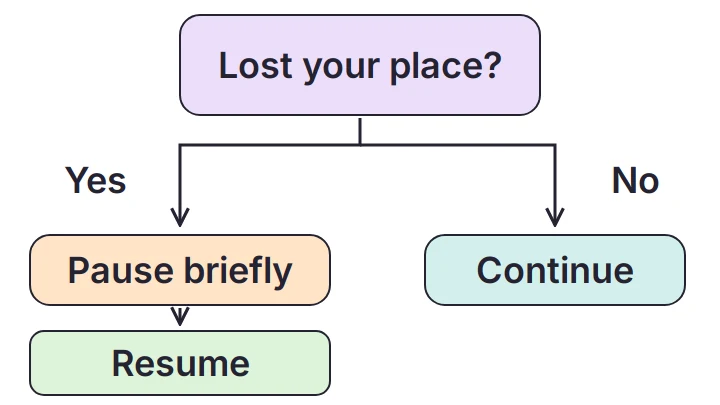
A stray thought alone tells you little about the paragraph you just read. Feeling busy also leaves a question about the form you filled in. What happened in the work is worth a look.
For a small check, try explaining the paragraph's point or inspecting the section you completed. This uses the finding as a prompt for your own trial. (Chen et al., 2026)
That sample may show a clear answer, a gap, or a place where you need to begin again. It gives your next attempt a concrete question. You have something to compare with the feeling of a scattered work block.
Quick tip · Remember this
Quick tip: Give your return note an action, such as “read the next paragraph.” This is a practical extension of switching research. (Leroy, 2009)
Two different attention games
Shoal asks you to follow the middle fish, then the crowd when the rule changes. Schulte Table asks you to find and tap shuffled numbers in order.
 Shoal
 Schulte Table
The tasks differ: Shoal includes conflicting directions and rule switches; Schulte Table involves finding the next number. These game mechanics do not establish better school results or clinical benefits.
Related site links: Cleverini research and research by country.
Common questions
-
How can I reduce phone interruptions while studying? Try silencing alerts or moving your phone away for one work block. The experiments measured cognitive capacity; they did not prove a homework benefit. (Ward et al., 2017)
-
Do short breaks help concentration? They preserved performance in specific lab tasks. These studies do not establish the best break length or schedule for everyday work. (Ariga & Lleras, 2011)
-
What is the difference between concentration and mind-wandering? Here, concentration means attending to your chosen task; mind-wandering means thoughts move elsewhere. In one lab preprint, breaks preserved performance without reducing mind-wandering rates. (Chen et al., 2026)
-
What can I do after an interruption? Try a note that names your next action. This is a practical extension of switching research; that exact note routine was not tested. (Leroy, 2009)
Your next work block may still include a call from the next room. Try leaving yourself one clear action to return to. That is a small planning choice you can test today.
Sources
-
(Leroy, 2009). Sophie Leroy. (2009). Why is it so hard to do my work? The challenge of attention residue when switching between work tasks. Organizational Behavior and Human Decision Processes. Source.
-
(Ariga & Lleras, 2011). Atsunori Ariga, Alejandro Lleras. (2011). Brief and rare mental “breaks” keep you focused: Deactivation and reactivation of task goals preempt vigilance decrements. Cognition. Source.
-
(Ward et al., 2017). Adrian F. Ward, Kristen Duke, Ayelet Gneezy, Maarten W. Bos. (2017). Brain Drain: The Mere Presence of One’s Own Smartphone Reduces Available Cognitive Capacity. Journal of the Association for Consumer Research. Source.
-
(Chen et al., 2026). Siyu Chen, Andrea Stocco, Brianna L. Yamasaki. (2026). Maintaining Performance Without Reducing Mind-Wandering: Exploring the Impact of Short Breaks during Sustained Attention Tasks. Center for Open Science. Source.

More from the blog
Why Can't I Focus When Reading? 5 Fixes to Try Today
Reading whole pages without taking them in? Try five small habits to recall the main point, spot gaps, and return to the text.

How to Focus on Homework: 5 Fixes That Actually Work
Learn how to focus on homework with five evidence-informed habits, practical steps, and clear research limits for students and parents.

