
Search a crowded screen with a route instead of random jumps
When you keep checking the same places, a simple search route can make your next move clearer. Here is how to test one without treating it as a universal rule.
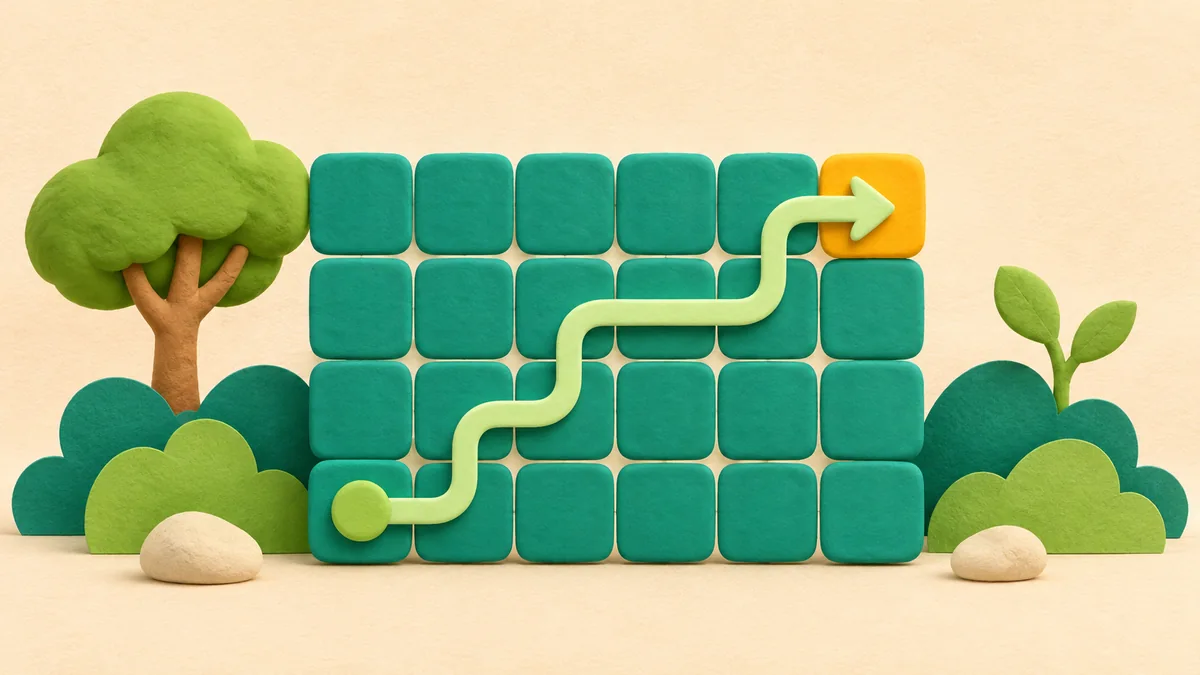
The item you need might be right in front of you, yet your eyes keep returning to the same corner. On a crowded screen, an unclear search can feel like a shortage of effort. Sometimes the more useful change is a route: a way to know where you have looked and where you will look next.
There is no single pattern that suits every display. A word grid, a table of numbers, and a shelf of objects have different structures. The goal of this exercise is to compare a deliberate route with your usual approach, then keep the parts that help you search that kind of material.
First, describe the target
Before deciding how to scan, say what you are trying to find. Is it the next number, a particular word, or an object with two specific features? A route cannot rescue a vague target. If the task asks for a blue triangle, searching for anything blue and forgetting the shape still gives you the wrong set of possibilities.
Try Schulte Table when you want a clear example: the task is to find numbers in order. The order tells you what comes next, but it does not automatically tell you where to look. That is the part you can examine.
Give the display a simple structure
For a rectangular arrangement, test one of these approaches before choosing a favorite:
- Rows: move across one row, then begin the next.
- Columns: work down one column before moving sideways.
- Zones: divide the display into a few areas and inspect each in a consistent order.
Use the structure as a reminder, not a rigid command to ignore something obvious. If you already see the target elsewhere, you do not need to pretend you have not noticed it. The route is most useful when you are uncertain and starting to revisit places without a reason.
Run a comparison you can interpret
Play one short round as you normally would. Afterward, note whether you repeatedly searched the same area or lost track of your next target. Then try a similar round using one planned route. Keep the device and viewing position the same if possible. Avoid changing the game and your strategy at the same time.
A different board can be easier or harder, so do not crown a winner from one score. Instead, ask questions about your process. Did you know where to look after each unsuccessful check? Did you notice repeated visits? Did the route feel helpful only at the beginning, or throughout the round?
Find the point where the route stops helping
A strict scan may be unnecessary when the target stands out immediately. It may also be a poor fit for a task that depends on moving objects or a changing rule. If the pattern draws your attention away from the actual instruction, change it. A strategy serves the task, not the other way around.
You can also make the route smaller. Instead of applying it to the entire display, use it only within the region where you are stuck. This keeps a useful sense of order without turning a quick game into a slow inspection of every tile.
Use the idea away from the game
Try a separate, ordinary search such as checking a shopping list against a shelf. Decide on a route for that setting and see whether it reduces repeated checking. Do not assume that a better game round has already changed your everyday search habits. Practicing the actual everyday task is how you find out whether the idea fits there.
Finish with a practical note: “Rows helped when the target was not obvious,” or “Zones made me forget the next number.” Either result is useful. You are building a small library of approaches, with a reason to use each one.

More from the blog
Why Can't I Focus When Reading? 5 Fixes to Try Today
Reading whole pages without taking them in? Try five small habits to recall the main point, spot gaps, and return to the text.
How to Improve Concentration: A Simple Daily Routine
Learn how to improve concentration with five practical habits for fewer interruptions, clearer task returns, and brief pauses, with evidence explained.

