
Trace where space returns before filling your last empty flask.
How to Win Water Sort Puzzle: Plan Your Next Pour
Learn how to win water sort puzzle levels by tracing where empty space returns, checking pour capacity, and planning around buried colours.
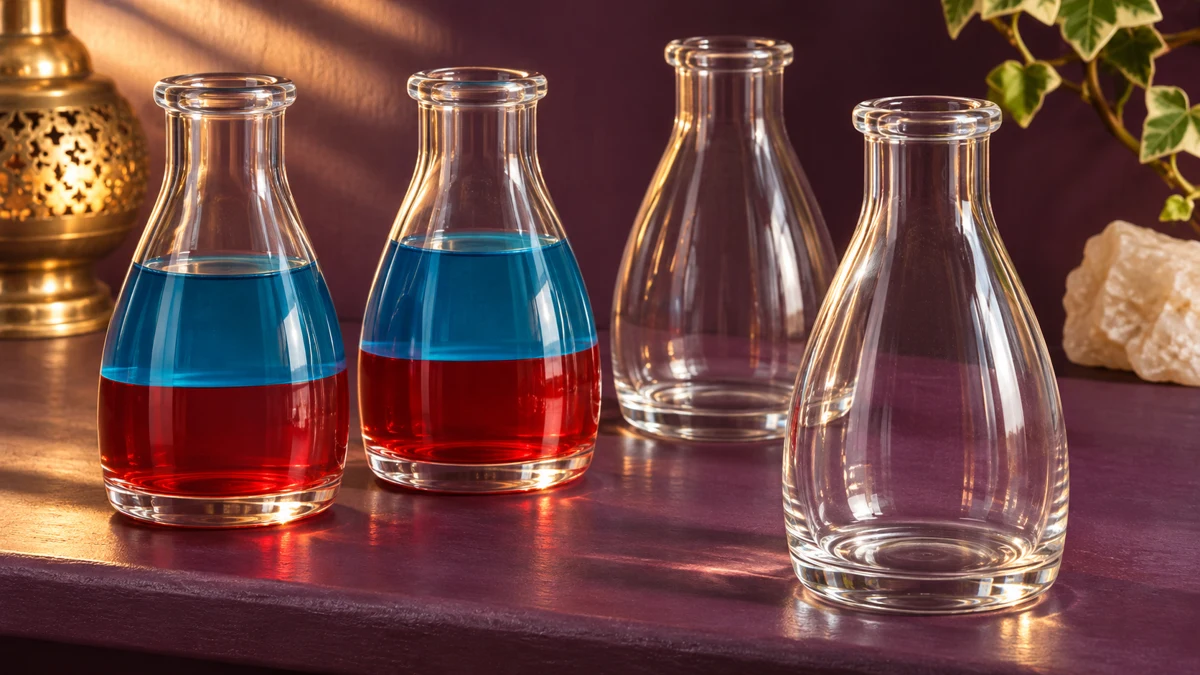
Trace where space returns before filling your last empty flask. Follow the next few pours until another flask empties or a colour is finished. The empty space lets you move a top colour aside so you can reach the one underneath.
In water-sort puzzles, the top layer controls the pour. In Potion Sort, a top colour pours onto the same colour or into an empty flask, and as much of that colour moves as fits. Four layers of one colour complete a flask, which gets a cork. A legal pour can still leave the colour you need covered.
 Potion Sort
 Look at the exposed top colours and the space above each stack.
Follow the space through a short sequence
The small practice position below has two colours and four flasks. Each flask holds four layers. The letters identify the flasks, and the colour names make the example readable without relying on colour alone. Both mixed flasks are full, so the first pour needs an empty destination.
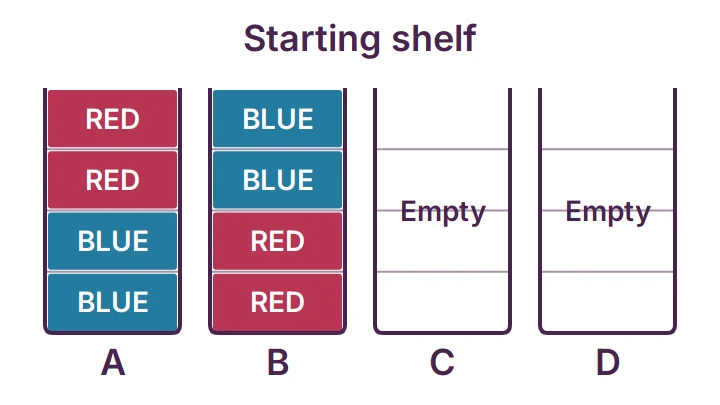
Pour A into C first: A's red layers leave together, so blue becomes available in A, and B's blue layers can then pour into A to complete its blue stack. B's red is now exposed.
Pour B into C to finish red. B is empty, and D has stayed empty throughout. Moving the red out of A gave B's blue a matching destination with room.
A temporary move needs an exit when it uses the last empty flask. Follow the colour placed there: where will it go later, or which other flask will become empty? If that colour stays trapped there, the next mixed stack has fewer places to pour. Potion Sort's own advice is to keep an empty flask free for as long as possible.
A matching colour still needs room
A long run of matching layers on top offers more layers in one pour. Potion Sort moves as much of that run as the destination can hold. Check long runs early, especially when moving one would expose a colour with an available destination. The run's length alone does not tell whether the pour helps.
In the position below, one free slot limits the pour. The destination accepts only one red layer, even though the source has two red layers on top. Green stays covered. A plan that needs to move green next stops here.
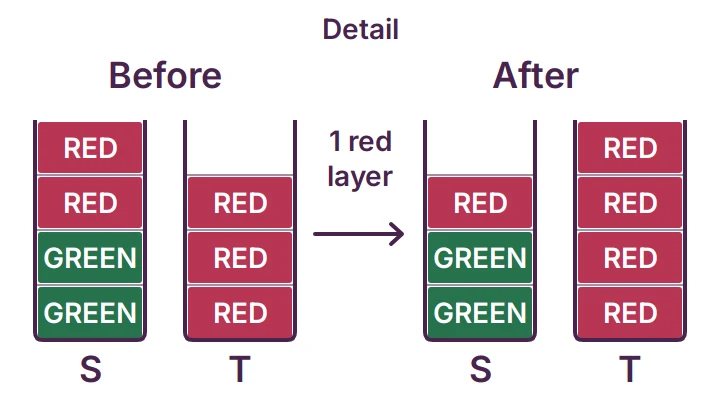
Compare the shelf after each possible pour. A newly exposed colour or an empty flask can make another pour possible. In Potion Sort, completed flasks are corked and set aside. Check whether the pours leading to a finished colour also free layers needed elsewhere. Pouring a colour away and immediately pouring it back spends moves and restores the old position.
When the shelf stops moving
Potion Sort gives five undos per level. Use an undo to revisit the pour that filled your last empty flask or the destination that had less room than expected. Before pouring again, name the colour your replacement will uncover and check where it can go. Otherwise another legal pour can lead back to the same blockage.
After the undos are used, scan every exposed top colour for a matching flask with room or an empty flask. A blocked plan may still leave other legal pours. If no legal pour remains, pouring cannot change the shelf. On a fresh attempt, carry forward the choice that caused the blockage rather than trying to remember every move.
Remember this
Record the decision that closed the route. A short note such as last empty flask filled while yellow was still buried identifies something to check earlier on the next attempt. A complete move list is harder to use during play.
The game also provides one extra empty flask per level. Give the added space a specific job, such as holding a top run while the colour underneath moves elsewhere. Trace those pours before taking the extra flask so the added space has a place in your plan.
From level 51, cloudy layers reveal their colour at the top in Potion Sort. Plan through the visible layers until a pour reveals a new colour, then check the shelf again. Each potion also carries a rune, so similar-looking colours can be matched by shape. A note of the flask and its newly revealed colour can help when that colour needs a destination later.

More from the blog
Why Jigsaw Puzzles Are Good for Your Brain (Honestly)
Jigsaws use visual and spatial skills. See what a study of adults over 50 found, what each piece asks of you, and how to choose a puzzle for enjoyment.
How to Make Change Fast: Count Up From the Price
Learn how to make change by counting up from the price, rehearse two $20 sales, and handle a customer who adds a coin during the count.

