
Start with an empty cell whose row, column and box rule out every digit except one, so your first answer needs no guess.
How to play Sudoku: Rules for Your First Grid
Learn how to play sudoku with the basic rules, a worked first move, pencil marks and a clear guide to rows, columns and boxes.
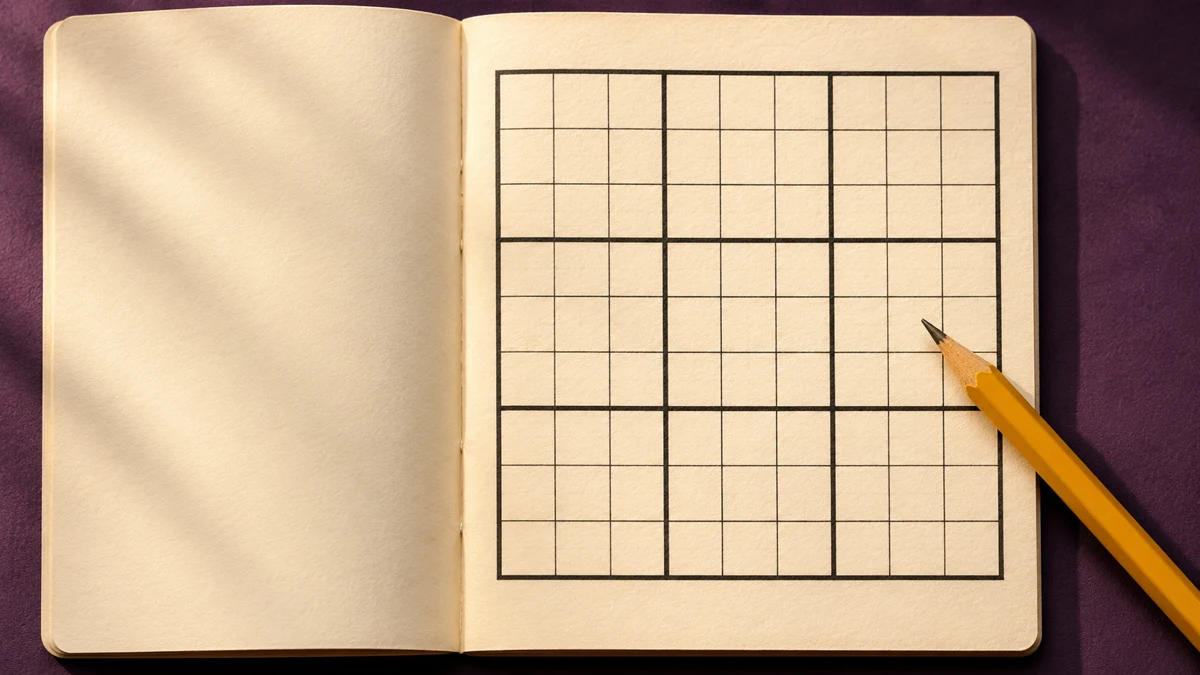
A Sudoku grid starts with some numbers filled in and a lot of empty squares. For your first game, the hard part is seeing how the numbers around an empty square tell you what belongs there.
Start with an empty cell whose row, column and box rule out every digit except one, so your first answer needs no guess.
Every row, column and box must contain the digits 1 to 9 exactly once, as described by Ahmad et al. (2019). For your first grid, that gives you a way to check a number before writing it.
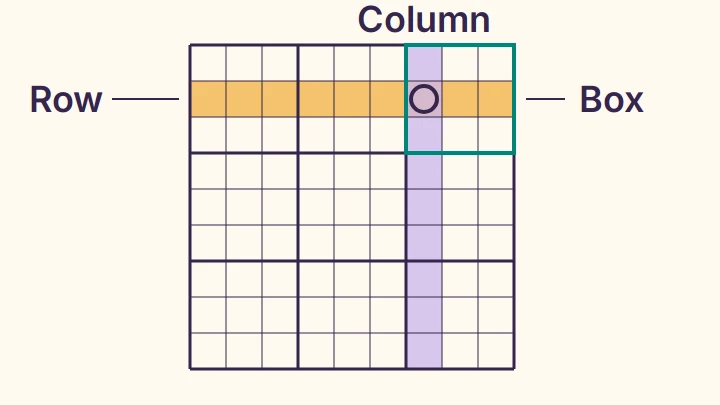
The numbers already printed on the board are clues, and they stay fixed. Empty cells are where you enter answers. A clue counts in its whole row, its whole column and its box, so follow the lines beyond the thick box borders when checking a cell. A digit at the far end of a row still rules that digit out of every empty cell along that row.
Digits repeat across the board because separate rows, columns and boxes each need their own complete set. Two 8s can appear in different places if they share no row, column or box. Sudoku uses numbers as labels, so there is no adding or multiplication. You also do not have to fill the grid in reading order: any empty cell that the clues let you solve can be your starting point.
A first move in the centre
Its row already contains 4, 8, 3 and 1. The digits missing from that row are 2, 5, 6, 7 and 9. Those are the possibilities to carry into the column check.
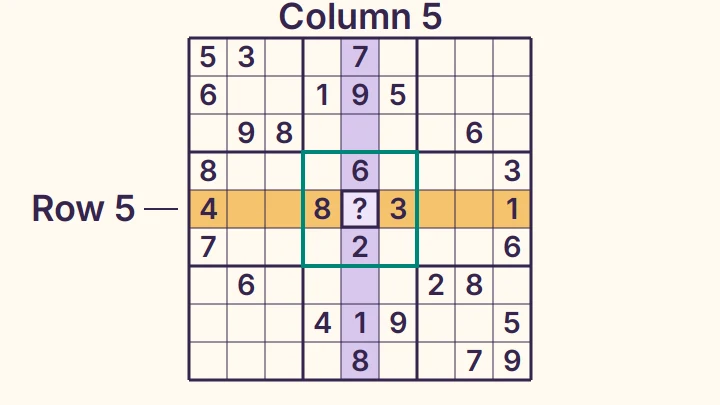
The centre column contains 7, 9, 6, 2, 1 and 8. Of the row's missing digits, that rules out 2, 6, 7 and 9, leaving only 5. A digit can be missing from the row and still be blocked by the column. Here, the two lines together have narrowed the choice to a single digit.
Before writing 5, check the centre box as well. It contains 6, 8, 3 and 2, with no 5. You can now enter the answer and explain the placement: the row and column ruled out every other digit, and the box allowed the one that remained. Every later placement needs the same checks, even when one group seems to give the answer straight away.
After that placement, some cells still have choices. In the same grid, the cell in row 5, column 7 allows both 7 and 9.
Neither appears in its row, column or box. Passing the checks makes both digits candidates, so there is no reason yet to choose between them. Leave that cell open while you find another answer.
| Mark on the board | Meaning | What to do |
|---|---|---|
| 🔒 Printed clue | Given digit | Keep fixed |
| ✅ Entered answer | Solved digit | Check if a conflict appears |
| ✏️ Pencil note | Possible digit | Remove when ruled out |
| □ Empty cell | Unknown answer | Check candidates |
On paper, small pencil notes in a corner keep possibilities separate from answers. A large 7 in a cell that still allows 9 looks solved, and later moves can depend on that unproved choice. If another answer later puts 7 in the same row, column or box, remove the 7 note. The remaining 9 can then be checked as the answer.
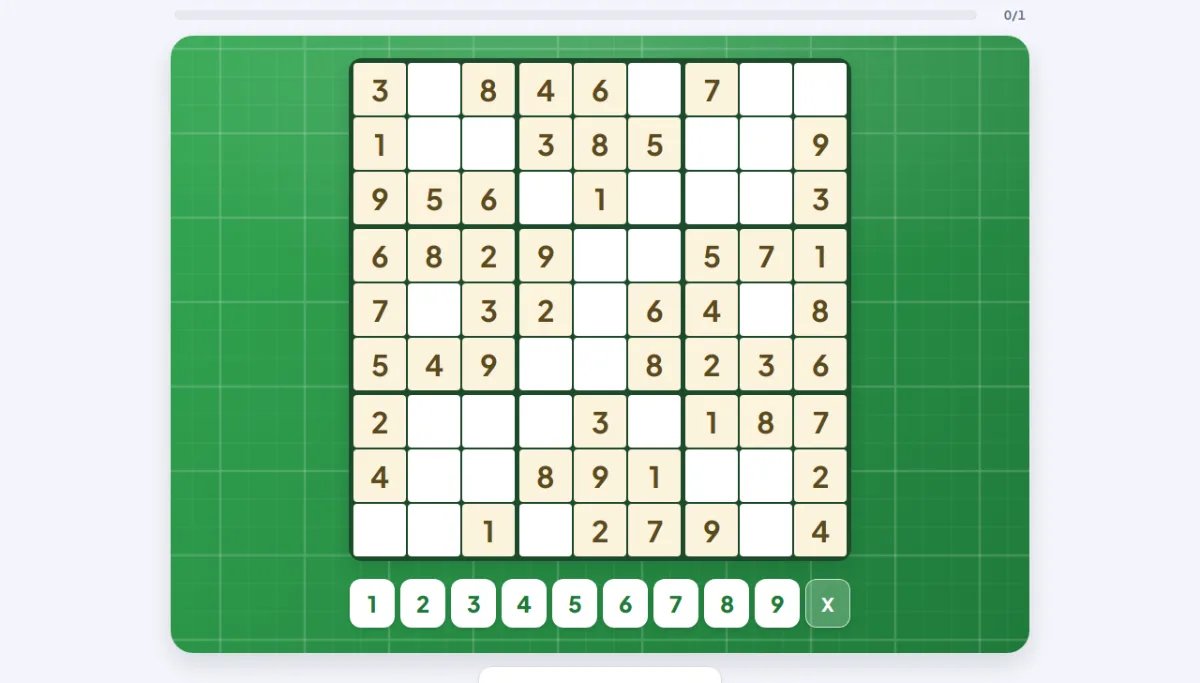 Look for the thick box borders and the digit keypad below the grid.
Carry that check through the grid
For a first online game, choose a single-player board so you can work through each placement. In Cleverini Sudoku, create a free account, choose Single player, select an empty cell, then select a digit on the keypad below the grid. The printed clues stay fixed. Use the row, column and box check before entering each answer.
 Cleverini Sudoku
With the controls understood, scan the fullest areas first. A row with one gap gives a short search: identify its missing digit, then check the gap's column and box. A box with several empty cells takes more checking. Starting where less is missing keeps the next decision small enough to explain without holding the entire board in mind.
When progress stops, check another part of the board before choosing a candidate at random. A nearly full column may offer a move even when the box you were studying still has several possibilities. Each confirmed answer supplies information to the cells that share its groups. Keep pencil notes up to date as those answers rule out candidates.
A repeated digit calls for a review of the answers you added. Trace the row, column or box containing the repeat, keeping printed clues fixed. Recheck each entered answer against all its groups. A placement can fit its row and still break the rule in its box, so checking only the line where you spotted the repeat can miss the mistake.
Remember this
A full board needs a final check. An occupied square can still hold a wrong digit.
The last empty cell follows the same rules as the first. After filling it, check that every row and every column contains a complete set of 1 to 9, and check each box too. The puzzle is finished after that final check.
Sources
- (Ahmad et al., 2019). Nur Intan Syafinaz Ahmad, Nurhuda Ismail, Ahmad Khudzairi Khalid, Muhammad Syawal Abd Halim. (2019). SOLVING DIAGONAL SUDOKU PUZZLE 9X9 GRID BY JAVA PROGRAMMING ALGORITHM. Journal of Information System and Technology Management. Source.

More from the blog

2048 Strategy: How to Merge Higher Without Getting Stuck
2048 strategy for stalled boards: keep matches reachable, protect useful space, and plan Number Drop moves with the NEXT preview.

Why Jigsaw Puzzles Are Good for Your Brain (Honestly)
Jigsaws use visual and spatial skills. See what a study of adults over 50 found, what each piece asks of you, and how to choose a puzzle for enjoyment.

