
You understand “reluctant” in a story, then it slips away in a chat. Recall a few words, check them, and bring them back later.
How to Improve Vocabulary: Small Word Sets That Stick
Learn how to improve vocabulary with small word sets, recall checks, and spaced reviews. Five practical habits for students and adults.
You meet “reluctant” in a story and understand the sentence. Later, you want that word in a chat, but it slips away. If you wonder how to improve vocabulary, that gap gives you a place to start.
Work with a few words, hide their meanings, and try to recall them before checking. Return to them later, so your practice includes more than the first look (Barcroft, 2007); (Alakbarova & Ball, 2023).
A small set keeps this task easy to return to. The studies here do not establish a perfect set size or a fixed pace of growth. The five habits below turn that simple plan into something you can try.
How to improve vocabulary with five habits for words you can bring back
Suppose your set contains “reluctant,” “brief,” and “notice.” Three is a workable choice for this example. It gives each word room without making a long list the price of starting.
For “reluctant,” cover “not willing or eager” and explain the meaning. “Not keen to do it” captures the sense, even though the wording differs. Then uncover the answer and check your attempt (Barcroft, 2007).
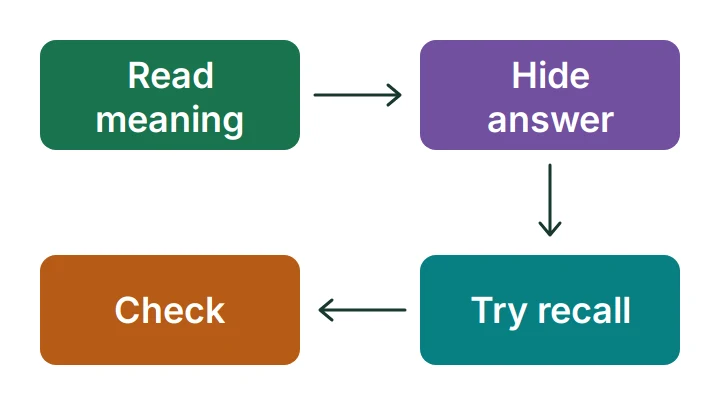
The useful step is recall before checking. A blank answer shows where you needed help today. It gives you a word to bring back in the next session (Barcroft, 2007); (Alakbarova & Ball, 2023).
Your first attempt at “reluctant” now has a follow-up. An entry such as “next review: after lunch tomorrow” makes the return concrete. That timing is a planning example; the study used two-day gaps (Alakbarova & Ball, 2023).
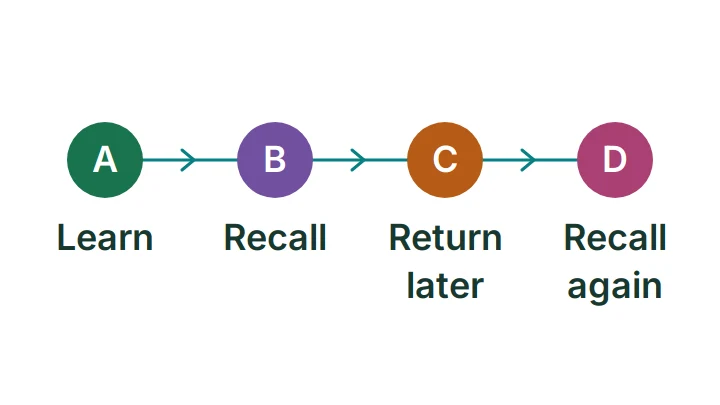
Keep the same words in that later check. A new set may feel fresh, but it gives the old words no further recall attempt. Returning across sessions is the part supported by the vocabulary experiments (Alakbarova & Ball, 2023).
That leaves a reading question: which words belong in your small set? Your own needs can guide the choice. The studies do not rank the words that matter for your class, work, or conversations.
“He was reluctant to lend his new bike” gives the word a setting. The request and the bike help make sense of his unwillingness. A checked meaning beside the sentence lets you see whether your guess fits.
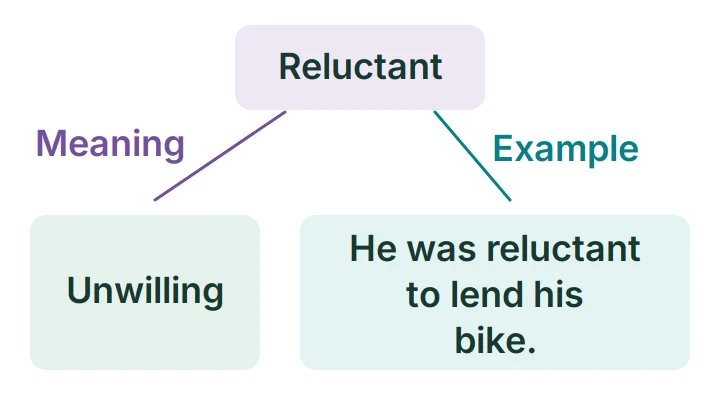
For vocabulary while reading, saving one useful sentence is a manageable way to apply this habit. Revisit it with the word’s meaning hidden (Nakata & Elgort, 2021).
The study tested learning from sentences, rather than how often readers should stop. Choosing only a few words is a practical limit for this routine. It leaves room to follow the story as well as notice its language.
The chart shows why the timing of a check matters. After one week, the recall condition retained 56% of prose ideas; the restudy condition retained 42%. These are learning conditions in a passage experiment with university students (Roediger & Karpicke, 2006).
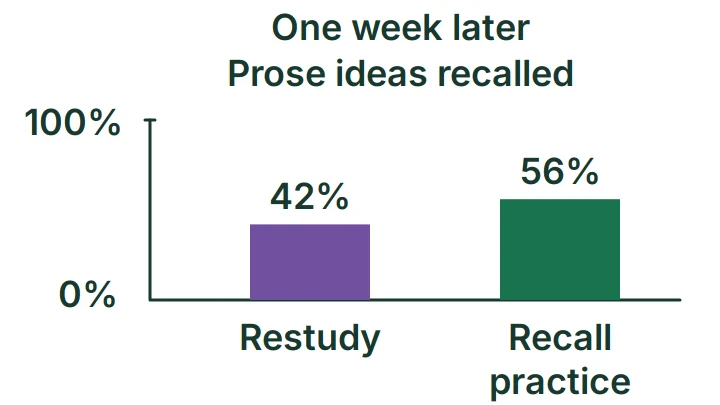
University prose recall after one week: 42% after restudy, 56% after recall practice. (Roediger & Karpicke, 2006)
Those percentages do not predict how many words you will remember. The spaced vocabulary experiments give more direct support for returning to words later (Alakbarova & Ball, 2023).
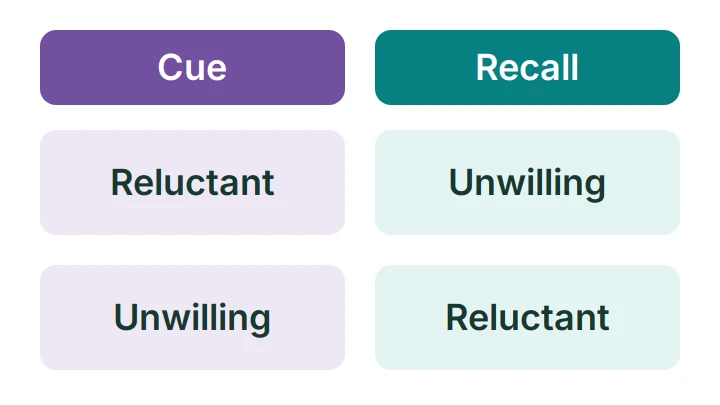
You may explain “reluctant” with ease yet struggle to find it from “unwilling.” That difference describes today’s answers. Two kinds of check make the gap visible without claiming to measure your whole vocabulary.
Quick tip · Remember this
Quick tip: Note “meaning hard” or “word hard” beside a miss. Use that note to choose your next recall question; this is a planning aid based on the two vocabulary measures (Nakata & Elgort, 2021).
Put the routine to work
Word Memory offers a ready-made set: five words with translations, then ten multiple-choice questions. Questions run in both language directions, with four answer options. You choose your languages before studying.
 Word Memory
That format differs from finding a word with no options. A game score shows your result on those questions. The cited studies do not establish vocabulary gains from this game.
For a different task, the Schulte table asks you to tap shuffled numbers in order. It offers 3×3, 4×4, and 5×5 grids. This is optional play, with no vocabulary-transfer benefit established by the studies here.
 Schulte table
For broader site context, see Cleverini research and countries. The sources below provide the specific evidence used in the habits.
Common questions
- How can I remember a new word after I first learn it?
Hide its meaning, try to recall it, and check. Return to that word in a later session (Alakbarova & Ball, 2023).
- Is it better to reread words or test myself on them?
Read the meaning, then add a recall attempt. Retrieval helped later vocabulary scores in the linked study (Barcroft, 2007).
- How can I learn vocabulary from reading without stopping at every word?
Save a useful sentence with a checked meaning and revisit it later. Selecting a few words keeps this routine manageable (Nakata & Elgort, 2021).
- How often should I revisit unfamiliar words?
Choose a later session you can keep. One study used two-day gaps, without establishing a best gap for everyone (Alakbarova & Ball, 2023).
- How can adults improve vocabulary quickly?
Try recall and return to the words later. The vocabulary experiments do not promise a fixed speed of growth (Alakbarova & Ball, 2023).
Sources
-
(Barcroft, 2007). Joe Barcroft. (2007). Effects of Opportunities for Word Retrieval During Second Language Vocabulary Learning. Language Learning. Source.
-
(Alakbarova & Ball, 2023). Durna Alakbarova, Hunter Ball. (2023). Spaced Retrieval Improves Retention and Transfer of Foreign Vocabulary. Center for Open Science. Source.
-
(Nakata & Elgort, 2021). Tatsuya Nakata, Irina Elgort. (2021). Effects of spacing on contextual vocabulary learning: Spacing facilitates the acquisition of explicit, but not tacit, vocabulary knowledge. Second Language Research. Source.
-
(Roediger & Karpicke, 2006). Henry L. Roediger, Jeffrey D. Karpicke. (2006). Test-Enhanced Learning. Psychological Science. Source.

More from the blog

Word Games for Adults: Free Picks for Every Player
Find free word games for adults beyond one daily puzzle, with guessing games, letter wheels, crosswords, and optional word-recall practice.
Find more words by changing the search route
When your eyes keep returning to the same letters, change the unit or direction of your search.

