
Learn one region’s country and capital pairs, test each direction separately, then mix regions after checking which pairs still get swapped.
Capitals quiz: Learn Cities by Region
Use a capitals quiz to untangle country and city names. Learn regional pairs, practise both directions, and revisit the names you mix up.
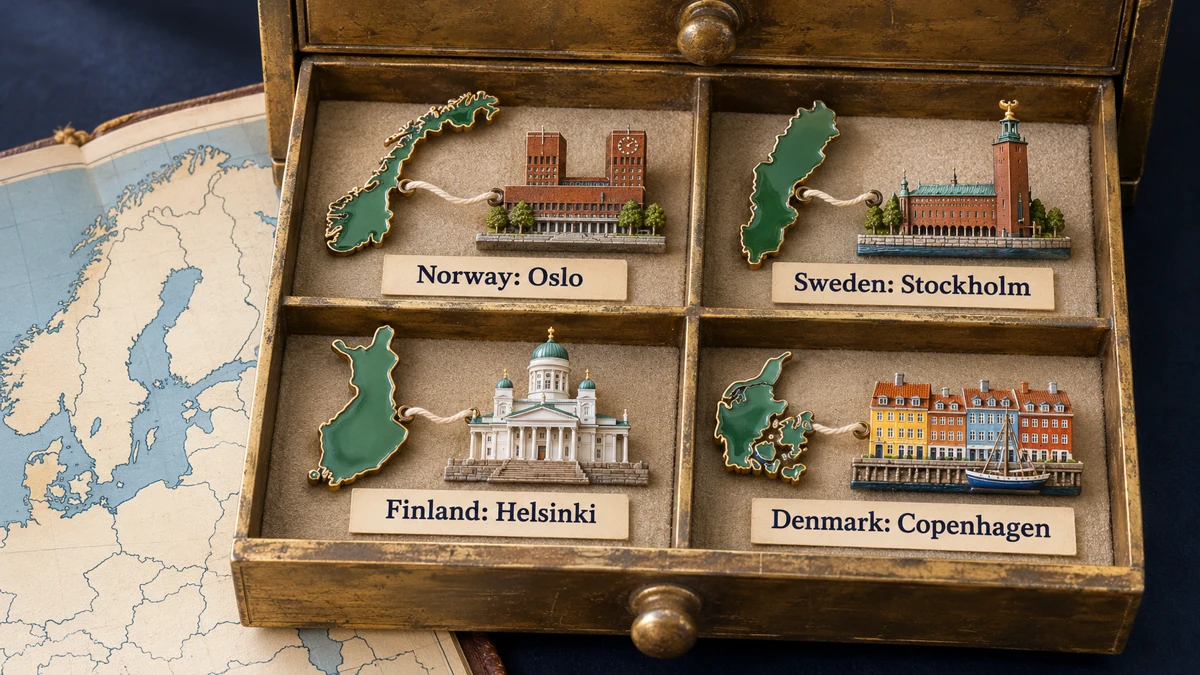
Country names and capital cities can look familiar while their partners keep getting swapped. If a capitals quiz leaves you choosing between names you recognise, start with a regional set that lets you check exactly which country belongs to each city.
Learn one region’s country and capital pairs, test each direction separately, then mix regions after checking which pairs still get swapped.
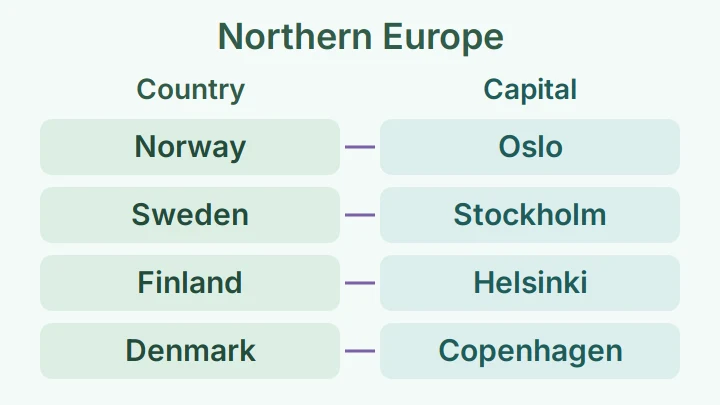
Start with the northern European set below. Give each country its own card, with the capital on the back, and keep this reference for checking. These four pairs make a complete first practice set, so there is no need to search through a world list between attempts.
When familiar names get swapped
Keep the country attached to its city. If Stockholm comes to mind for Norway, check both connections in the figure: Sweden with Stockholm and Norway with Oslo. Then cover the reference and try Norway again. Writing down only Oslo would leave the city you confused it with outside the repair.
A card with Norway facing up tests whether its capital comes to mind, while turning it over asks you to name the country from Oslo. Keep the answer covered. Say the hidden name aloud before revealing it, and count it as recalled only if it arrived without a look at the back.
Mark the direction that failed. If the country is easy to name but its capital keeps escaping, leave the country side facing up for the next attempt and give that direction more practice before returning to the full set.
The shuffle also removes a clue that can make a set feel learned too soon. In a fixed order, the last answer may be obvious because all the other names have already appeared, so put a missed card back among cards answered correctly. Its position changes. The next answer has to come from the visible name instead of what remains in the pile.
| Practice mark | What happened | Next attempt |
|---|---|---|
| ✅ Recalled | Answer before reveal | Keep in shuffle |
| ↩️ Swapped | Wrong partner | Retry that direction |
| 👀 Looked | Answer needed checking | Hide and retry later |
| ⏳ Hesitated | Answer arrived slowly | Retry without timer |
Let the quiz expose the loose pairs
Read which name the question wants. The Cleverini Capitals quiz asks both country-to-capital and capital-to-country questions. It covers 178 countries, gives three answer options and allows 10 seconds per question. Before choosing, check whether the missing name is a country or a city.
 Cleverini Capitals quiz
After practising the regional cards, use a round to meet those names among places from elsewhere. Unfamiliar questions can wait. Keep the cards nearby so that, after the round has tested your regional set among world questions, you can review mistakes with the timer no longer running.
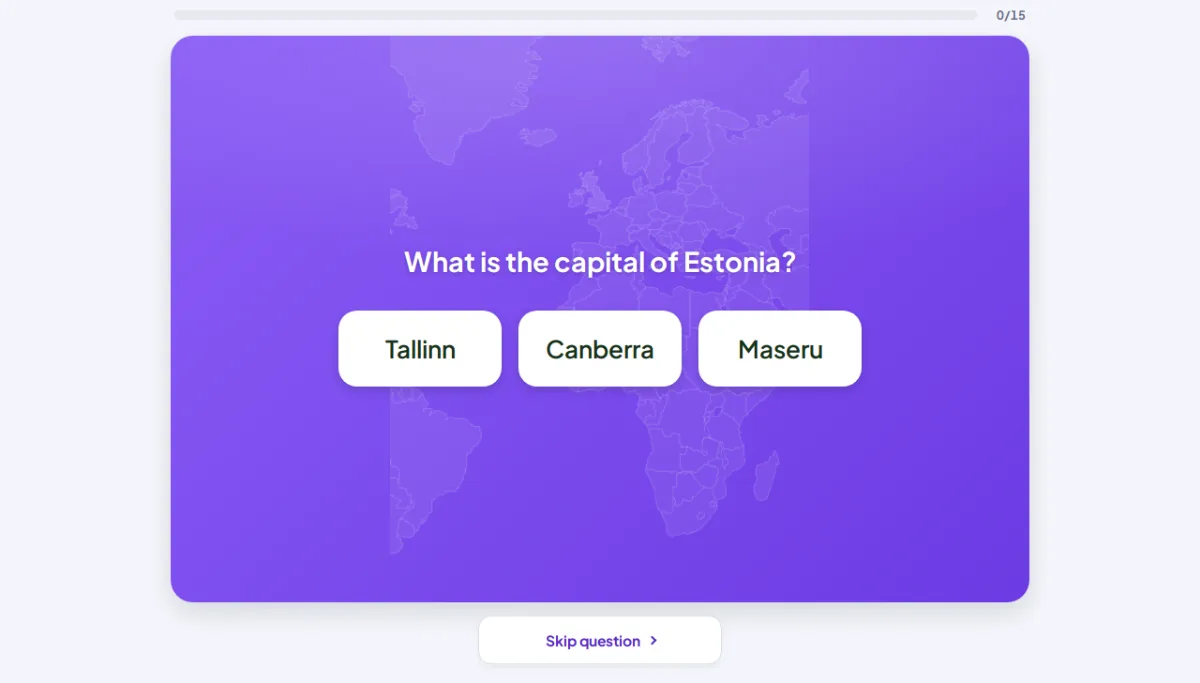
Look at whether the prompt asks for a country or its capital.
When a question goes wrong, record the country and capital together rather than copying only the correct button. Check the error first. If the mistake was choosing a country when the prompt wanted a city, add read the prompt beside the pair as a reminder to slow down on the next turn.
Add that note only after the city has appeared in your own mistakes, and keep it brief. A card covered with famous city names gives you more names to sort through while you are trying to learn one partner. The note can come off after a correct recall on a later day.
The game’s instructions also suggest ruling out options from the wrong continent. Regional knowledge can help you make that choice, even when the exact pair does not come to mind. Give an answer reached this way a separate mark so it gets a hidden-answer check afterward.
Remember this
After a guess or an answer by elimination, cover the options and try the pair again. If the name does not come to mind, return that card to practice.
Bring the region back on another day
Leave time before the next recall. In two experiments, people learned Swahili words and English definitions across sessions two days apart. A week later, those who had practised recalling the words remembered more than those who had repeatedly reread them (Alakbarova & Ball, 2023). For the capital cards, borrow the study’s practical action: attempt an answer from memory, then return to it on another day.
At that later attempt, try both faces before consulting the reference. Keep the previous pencil marks so you can see whether the same direction fails again. A pair recalled both ways can join a mixed set once the next region has had its own separate practice round.
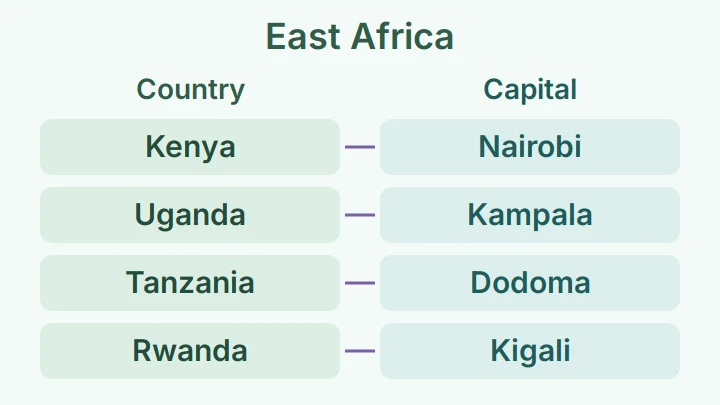
The East African pairs above supply that next set. Make their cards in the same way, then shuffle the two regional sets together after practising each separately. During mixed practice, a region label can be a clue when a name stalls. Cover it on the next attempt so the country or capital itself has to bring back its partner.
Keep a record you can use.
- Checking each direction separately shows whether the country name or the capital needs more practice.
- Recording the full mistaken pair lets you repair both connections when capitals get swapped.
Sources
- (Alakbarova & Ball, 2023). Durna Alakbarova, Hunter Ball. (2023). Spaced Retrieval Improves Retention and Transfer of Foreign Vocabulary. Center for Open Science. Source.

More from the blog
How to focus at work: Protect Time for Demanding Tasks
Learn how to focus at work with agreed reply times, urgent coverage, protected work blocks and a clear place to restart after interruptions.
Schulte Table: How to Use It and What It Trains
Use a Schulte table for a one-minute number-search exercise. Follow a round, compare time and mistakes, and understand why a score cannot prove better everyday focus.

