
Put sleep, movement and social contact first when building a routine to stay mentally active as you age.
How to Keep Your Brain Sharp as You Age: What Helps
Build a mentally active routine with sleep, movement, social contact and enjoyable learning, and see what puzzle and memory-training research shows.

Make time for sleep and movement when deciding how to keep your brain sharp as you age. Stay in touch with others, and keep learning through activities you enjoy returning to, such as reading, gardening, music or puzzles.
Retirement can leave long stretches without the conversations and tasks that once filled the day. Give the day a few anchors without filling every gap. The National Institute on Aging’s guide to cognitive health offers a broader starting point for caring for thinking, learning and remembering as people grow older.
A routine that survives retirement
Give sleep a place in the plan. A familiar bedtime routine gives the day a stopping point, especially when television or phone use stretches through the evening. If poor sleep keeps disrupting daytime life, bring it up at a healthcare appointment.
Movement has evidence for sleep benefits. A review of 14 exercise-program studies in generally healthy adults aged 60 and over found that all but one reported at least one improvement in sleep. The programs included activities such as tai chi and yoga. Sleep is a concrete reason to discuss suitable exercise with a clinician (Vanderlinden et al., 2020).
Walking, gardening, a seated class or a pool session offer different ways to make movement part of the week. Choose activity that fits your body, with existing pain, balance problems or a health condition in mind. A family member can help find an accessible place or join in, while the older adult chooses what appeals.
| What gets in the way? | A practical adjustment |
|---|---|
| 🌧️ Poor weather | Choose an indoor activity |
| 🚗 Getting there | Arrange transport first |
| 🪑 Uncomfortable standing | Ask about seated options |
| 🤝 Going alone | Attend with a companion |
A shared interest gives a conversation somewhere to go. Make contact around something enjoyable, such as a library group, a meal, a craft project or a regular call about a book. For a family member or carer, useful help includes arranging transport and making an invitation specific. Leave the choice of company and activity with the person taking part.
Choose a puzzle you want to return to
Start with a familiar interest. Word lovers can choose a crossword, while someone who enjoys deduction may prefer Sudoku. Paper puzzles are a choice alongside browser games. Large print, comfortable seating and readable screen settings can help make playing comfortable.
In Cleverini’s Crossword, the smaller grid offers a compact start. The game has 7×7 and 9×9 grids with definition clues. A correct word supplies letters for crossing answers, so one solved clue gives something concrete to work with elsewhere in the puzzle.
 Crossword
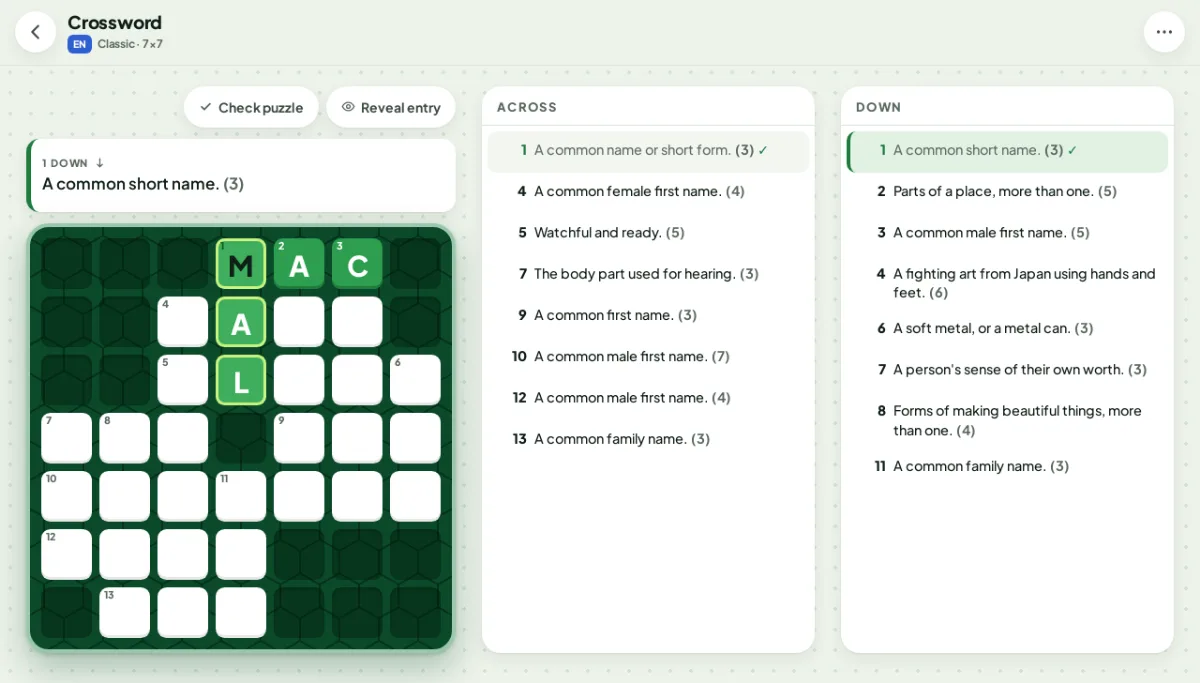 Each filled answer supplies letters for the words crossing it.
Help can stay under the player’s control. Crossword’s correct-word highlighting can remain on, and its menu includes Check and Reveal. Players can discuss clues with a companion or work quietly on their own.
Sudoku uses logic without arithmetic. In Cleverini’s Sudoku, each row, column and 3×3 box must contain the digits 1 to 9 once each. The game offers solo play and a shared board where players take turns.
 Sudoku
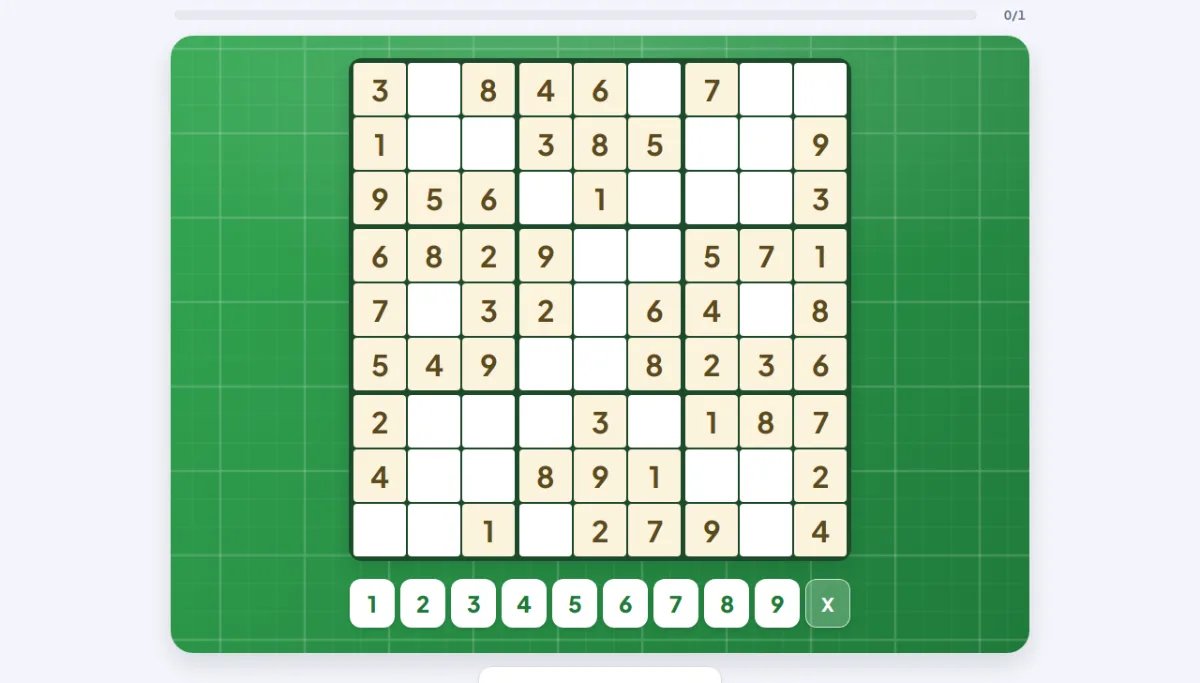 The rows, columns and smaller boxes determine which digits can fit.
A game score measures that game. It does not assess how someone manages daily tasks. Keep scores out of family discussions about whether an older relative is coping at home.
Structured training produced small test gains in a review of 52 trials involving 4,885 older adults without cognitive impairment. Attention showed no significant training benefit. The review tested organized training programs, not casual browser puzzles. It gives no reason to choose a browser game as a way to improve attention (Lampit et al., 2014).
Remember this
A puzzle can remain unfinished. There is no need to complete a grid in one sitting. Leave it when you want a break, and return if you feel like playing again.
When a memory problem needs its own appointment
Bring everyday difficulties to a clinician. A new or worsening problem with familiar tasks or managing medicines deserves a conversation about that specific change. A family member can help record what happened and accompany the person if invited.
Describe the task that is going wrong. In a trial of 60 adults aged 50 to 87 who reported memory problems, both training groups reported improvements in personal memory goals lasting up to six months. The group taught memory methods reported greater improvement. That supports asking about structured help for an everyday difficulty (Frankenmolen et al., 2018).
Sources
-
(Lampit et al., 2014). Amit Lampit, Harry Hallock, Michael Valenzuela. (2014). Computerized Cognitive Training in Cognitively Healthy Older Adults: A Systematic Review and Meta-Analysis of Effect Modifiers. PLoS Medicine. Source.
-
(Vanderlinden et al., 2020). J. Vanderlinden, F. Boen, J. G. Z. van Uffelen. (2020). Effects of physical activity programs on sleep outcomes in older adults: a systematic review. International Journal of Behavioral Nutrition and Physical Activity. Source.
-
(Frankenmolen et al., 2018). Nikita L. Frankenmolen, Eduard J. Overdorp, Luciano Fasotti, Jurgen A.H.R. Claassen, Roy P.C. Kessels, Joukje M. Oosterman. (2018). Memory Strategy Training in Older Adults with Subjective Memory Complaints: A Randomized Controlled Trial. Journal of the International Neuropsychological Society. Source.

More from the blog
Brain Games for Kids: Free Online Picks by Skill
Choose brain games for kids by skill and age, with free online picks for memory, attention, maths, words and colour perception.

How to Improve Attention Span: Small Daily Steps
Learn five small attention habits, what the studies support, and how to try clearer task steps, brief pauses, phone changes, and sleep time.

