
Want to judge claims more clearly using five questions to separate facts, test rules, compare options, and choose your next check?
How to Improve Critical Thinking: 5 Questions to Ask
Learn five questions to check claims, separate facts from assumptions, test rules, and compare options, with clear examples and optional games.

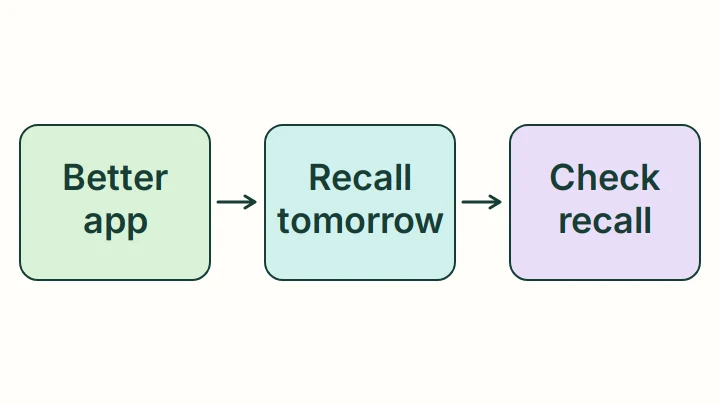
To learn how to improve critical thinking, start with a class chat and a claim: “This study app is better.” A friend’s mark went up after using it. That sounds promising. But what does “better” mean?
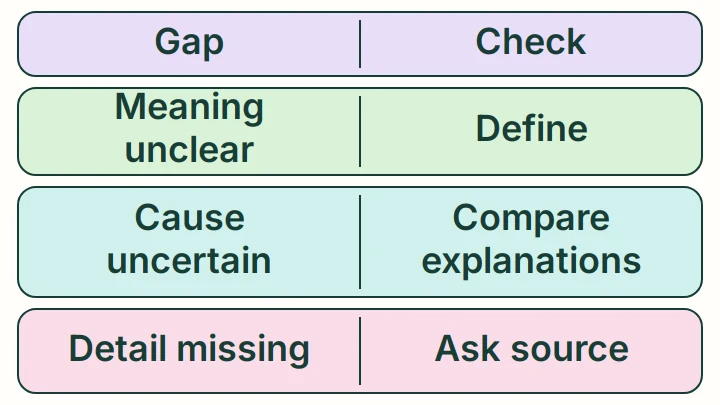
If you’re asking how to improve critical thinking, this is a useful place to start. Five questions can frame the check: what is claimed, what is known, what could disprove it, what matters, and what comes next?
The same questions apply to a work proposal or a shopping choice. Here, the study-app claim runs through each one. The examples are practical prompts, with the scope of their sources shown inside each card.
5 questions for clearer choices
“Better” could mean learning words, planning homework, or enjoying a break. Each meaning calls for different evidence. A high review score says little about next-day word recall on its own.
For this example, the revised claim is, “This app helps me recall words the next day.” That is a claim you can check. The result now has a clear meaning, even though its truth remains open.
| Vague wording | A clearer question |
|---|---|
| Better for studying | Which study task does it help with? |
| Helps me learn | What can I recall the next day? |
| Everyone likes it | Does liking it answer my learning question? |
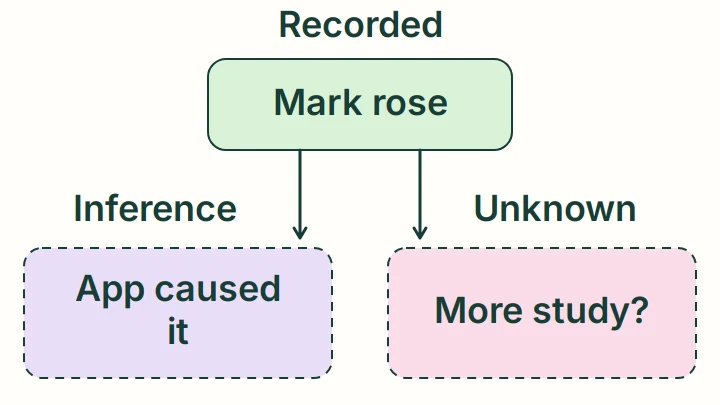
Back in the chat, the friend says their mark rose after changing apps. If the record confirms that rise, it is an observation. “The app caused it” adds an explanation.
The friend may also have studied longer, or the test may have covered easier work. These are possible explanations, still waiting for a check. Calling either one a fact would add an untested assumption.
| Given, if confirmed | Inferred or unknown |
|---|---|
| The friend changed apps | The app caused the higher mark |
| The recorded mark rose | Whether study time changed |
| One result was reported | Whether the same pattern holds elsewhere |
Now someone in the chat adds, “Every popular study tool must be useful.” A tool might be popular because it looks fun or gets shared widely. That gives the group something else to investigate.
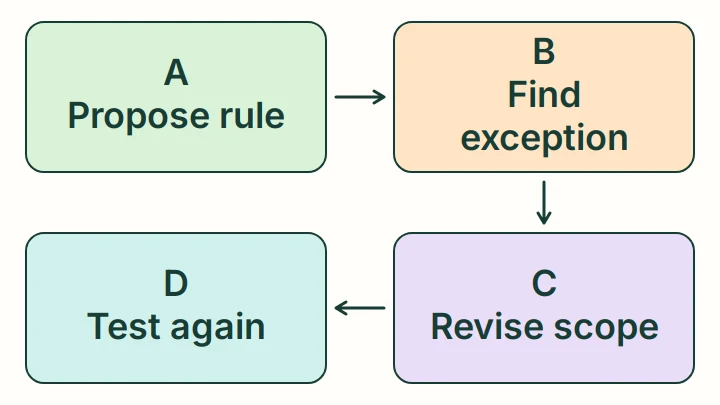
An imagined exception does not prove the claim false. A real popular tool with no relevant benefit would challenge it. A tool with an unclear benefit would leave the question open.
The wording matters here. One counterexample can defeat an “always” claim, while an “often” claim needs a wider look. A failed case may call for a narrower rule, followed by another test.
The chat has raised a claim; you still have a choice to make. Perhaps the app and a course both look worth considering. Price, travel time, and teacher feedback would answer different parts of that choice.
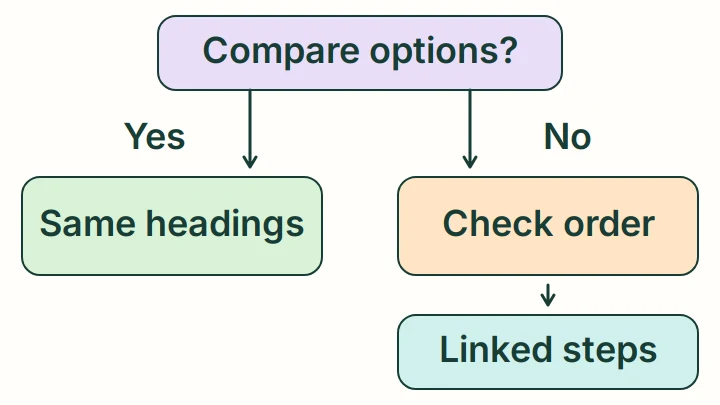
A fair layout gives both options the same questions. An unknown detail stays visible, instead of being filled with a guess. The table below is an empty comparison frame, with no claims about either option.
| Feature to check | App | Course |
|---|---|---|
| Price | Unknown | Unknown |
| Travel needed | Unknown | Unknown |
| Teacher feedback offered | Unknown | Unknown |
A table fits this side-by-side choice. An ordered set of steps would suit a check of how one conclusion follows from another. The task gives the display its purpose.
For the course, a sample lesson might answer a question about its content. For the app claim, the original source might reveal what was measured. Neither check answers every question, but each has a clear purpose.
“I’ll try the sample, then decide” leaves room for evidence to change the choice. The next check is tied to a gap. It also makes clear which part of the decision remains open.
An AI answer can enter the same chat. Its smooth wording leaves the source and the reasoning to inspect. The AI study above does not establish that any particular answer is sound.
Try the questions on one claim
Two games offer different settings for these questions. Their rules give you something specific to inspect. The sources above do not establish learning gains from either game.
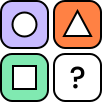
- Logic Challenge uses number sequences, pyramids, and numbered shapes. Each timed round asks for a missing number from six answers. The relevant question is whether a candidate rule fits every visible example.
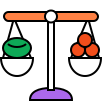
- Market Rush asks which produce basket is worth more. Prices matter, so the fuller basket can lose. A later half-price sticker adds another condition to the choice.
 Logic Challenge
 Market Rush
Quick tip · Remember this
Quick tip: Write “What would change my answer?” beside the claim. Use that question to name a check, as a practical reasoning prompt (Barwise & Etchemendy, 1996).
Cleverini’s research and countries page is another place to use these distinctions. Site activity totals alone cannot show a learning gain or a causal effect.
Common questions
- How can students start? A homework claim offers a starting point for the same five questions, from its meaning to a possible exception.
- How can adults use these questions? A work or shopping choice can involve the same gaps: unclear claims, missing details, and options compared on different terms.
- Are critical thinking games enough? No study has shown that these games improve everyday thinking. Here, games provide examples of rules and conditions to inspect.
- What is evidence rather than an assumption? Evidence is information you can inspect for a claim. An assumption is something you accept without checking here.
- What if I still cannot decide? The answer can stay open when a needed fact is missing. The fifth question helps name that gap and a possible check.
The chat began with “This app is better.” By the end, the claim has a clear meaning. Its evidence has limits, and the next question is visible.
Sources
-
(Barwise & Etchemendy, 1996). Jon Barwise, John Etchemendy. (1996). Visual Information and Valid Reasoning. Logical Reasoning with Diagrams. Source.
-
(Shimojima, 1996). Atsushi Shimojima. (1996). Operational Constraints in Diagrammatic Reasoning. Logical Reasoning with Diagrams. Source.
-
(Abbas, 2025). Mohamed Ali Abbas. (2025). Meta-Cognitive Problem-Solving: A Systematic Framework for Problem-Solving Verification. Springer Science and Business Media LLC. Source.

More from the blog

How to Stop Procrastinating: Make the First Step Tiny
Learn how to stop procrastinating with tiny homework starts, clear cues, obstacle plans and checkpoints before your deadline.

How to Play Mahjong Solitaire: Rules and Tips
Learn how to play Mahjong Solitaire: spot free tiles, match pairs, open blocked rows and use Hint, Undo or Shuffle when you get stuck.

