
Why a game score is not a verdict on your ability
Different rules, response units and samples make a single percentage much less portable than it looks.
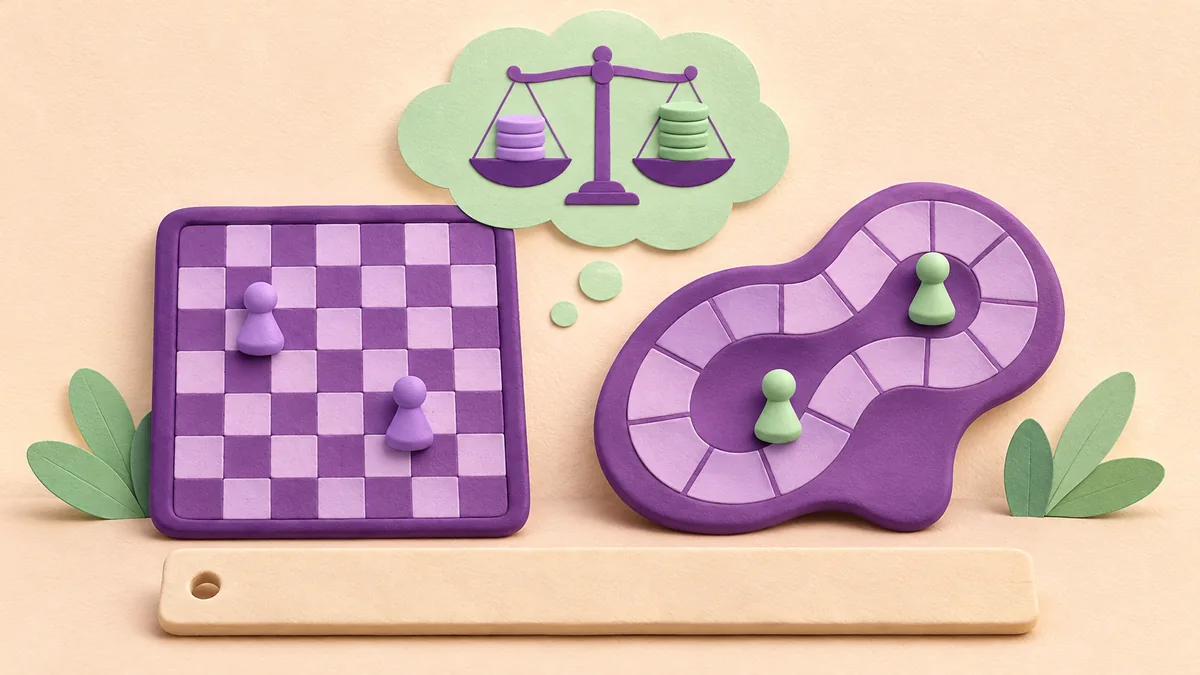
Two percentages sit next to one another on a chart: 52.6% for Twin cards and 89.6% for Colors. It is tempting to read them as a contest between two kinds of players, or two kinds of mind. The public data does not support either interpretation.
A game score is produced by a particular task. To understand it, you need to know what counts as an answer, what the player must choose and which rounds were recorded. A percentage without that context can look more comparable than it really is.
Read the denominator beside the result
In the Cleverini research snapshot generated on 11 November 2026, the Twin cards figure comes from 3,629 recorded answers involving 109 players. Colors contributes 7,646 answers involving 380 players. These are not equally sized groups, and the chart does not arrange them as matched participants in an experiment.
The larger public snapshot contains 92,416 answers since February 2024. That total helps describe the dataset as a whole, but it is not the denominator for each individual game. When you quote one game's percentage, keep that game's sample beside it.
Check what one answer means
In Twin cards, the public card describes an answer as a pair of cards turned. In Sudoku, each move counts as an answer. In Wordy, each guess counts. Treating all three as though they were identical questions would hide important differences in what the player is doing.
The chart also notes variation in time limits and the number of options, which can range from three to eight across the tasks covered. Those differences help explain why a lower accuracy percentage is not a straightforward measure of a player's general ability.
Use four questions before comparing
- Same task? Check whether the rules and response unit match.
- Same conditions? Look at level, time limit and any relevant device or interface differences.
- Same kind of sample? Ask who played and whether the observations include repeated answers from the same people.
- Same purpose? Decide whether you are comparing game difficulty, your own approach or something else entirely.
You may still find the chart useful. A lower accuracy rate can suggest a game where mistakes are common in this dataset. It can prompt a question about task design or how players approach it. It cannot tell you which skill every player needs to fix.
Make your personal review more specific
After a Twin cards round, note a response you want to inspect. Did you revisit a position without a clear recollection, or did you lose track of a pair you had already seen? Use a description you could check, rather than assigning yourself a permanent label.
Compare your own attempts cautiously too. A different level, a new device or a changed rule can alter the task. If you are testing one approach, keep the other conditions as similar as practical and record changes that could explain a difference.
Keep game progress close to its evidence
A research review by Simons and colleagues distinguishes improvement on practised tasks from evidence of wider transfer. That distinction is useful here: becoming more familiar with a game is a real observation, while a claim about unrelated everyday tasks needs its own evidence.
If remembering a work procedure is your goal, practise and check that procedure. Enjoy the game alongside it, but do not use a higher game percentage as the only evidence that the work task has changed.
Today's quick win: take one score and write beside it the task, level and one thing you noticed. If you cannot explain what the score counts, find that out before comparing it with another percentage. The public difficulty card includes the sample notes needed for this example.
Sources
Cleverini public snapshot, generated 11 November 2026 at 02:50:57 UTC, 'hardest-games' card; Simons and colleagues, Do Brain-Training Programs Work? (2016).

More from the blog
What our first-question timeouts can and cannot tell us
Our snapshot shows more timeouts at the start of a round. Here is the pattern, its limits and a modest practice check.

The Cleverini Country Cup: how to read a country ranking fairly
The Cup compares recorded play, not whole countries. Learn what a lead means and why small samples deserve care.

