Rotate shapes without rushing your first guess
Choose a landmark on the shape and follow its relationships instead of comparing silhouettes alone.
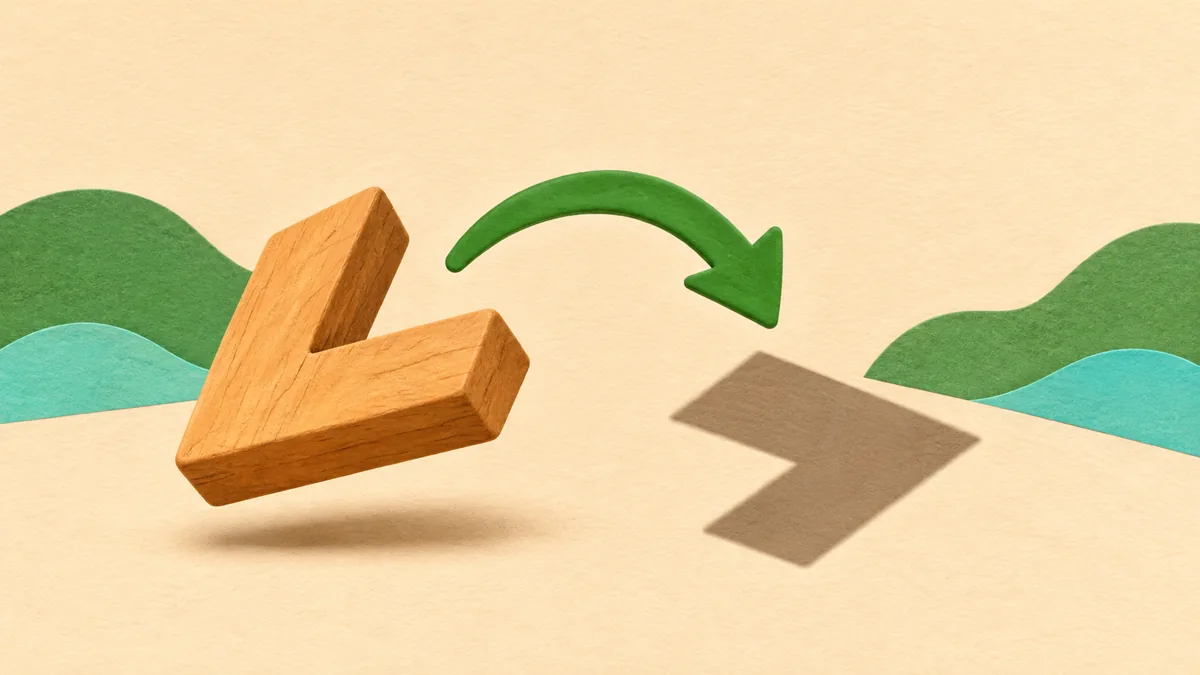
Two shapes look almost the same, but one is turned. You try to compare the whole outline at once and keep losing your place. A smaller comparison can help: choose one distinctive feature and follow the parts connected to it.
For this exercise, think of a shape built from a few connected blocks. Use a landmark, a direction and a check. You can do the exercise with a drawing or an ordinary object. It is a practice method to try, not a test of whether you are a spatial thinker.
Keep rotation and reflection separate
Turning an object changes its orientation. A mirror image may reverse a relationship that no ordinary turn can reproduce. Before deciding that two outlines match, look for a feature that would expose that reversal, such as a branch that bends to one side after an upright section.
A classic experiment by Shepard and Metzler used comparisons of rotated three-dimensional block drawings. It studied the time taken to judge the depicted shapes. Our landmark exercise is an everyday suggestion inspired by the kind of comparison, not a reproduction of that experiment or a claim about your abilities.
Choose a landmark you can keep track of
- Find an anchor. Look for an unusual end, a long arm or a corner that is not repeated everywhere.
- Describe its neighbour. Say which segment comes next and how it connects.
- Imagine a single turn. Follow those connected parts through the turn rather than rebuilding the entire shape in your mind.
- Check a second feature. A matching anchor is not enough if another branch points the wrong way.
For example, picture a short upright stem with an arm extending sideways near the top. Follow the joint between the stem and arm. If you mentally turn the object, both pieces must move together. You cannot rotate one arm independently unless the task explicitly allows it.
Use a physical comparison when practising
Pick a safe household object with an uneven outline, such as a mug with a handle. Observe it from one position, predict how the handle will appear after a small turn and then turn it to check. Do not use a fragile object or stand somewhere awkward for the exercise.
You can draw a simple block shape instead. Make a prediction before moving the paper, then compare. If your prediction was wrong, locate the first relationship that changed in your imagined version. That is more informative than simply drawing a more complicated shape next time.
Bring the check to Shape Spin
In Shape Spin, read the task's actual instructions and choose an anchor that is visible on screen. After the round, consider whether your first response relied on one similar-looking feature or on the relationships between several parts.
Practising this game can make you more familiar with its displays and decisions. If your everyday goal is reading a furniture diagram or planning how an object fits in a box, practise with that material too. Similar-looking tasks still have different demands and useful checks.
Slow the comparison without abandoning it
When the picture feels slippery, return to the anchor rather than repeatedly scanning everything. You can also describe the connection in words or make a small sketch. Use whichever representation helps you check the relationship accurately.
Today's quick win: choose one uneven object, predict a small turn and verify it physically. Keep the first attempt simple. Your goal is to find a feature you can follow consistently, not to complete the largest possible rotation in one leap.
Source
Shepard and Metzler, Mental Rotation of Three-Dimensional Objects (1971). Primary study of comparisons between rotated block drawings.