Look for the rule, then try to break it
Treat your first pattern as a candidate and check where it could fail before choosing an answer.
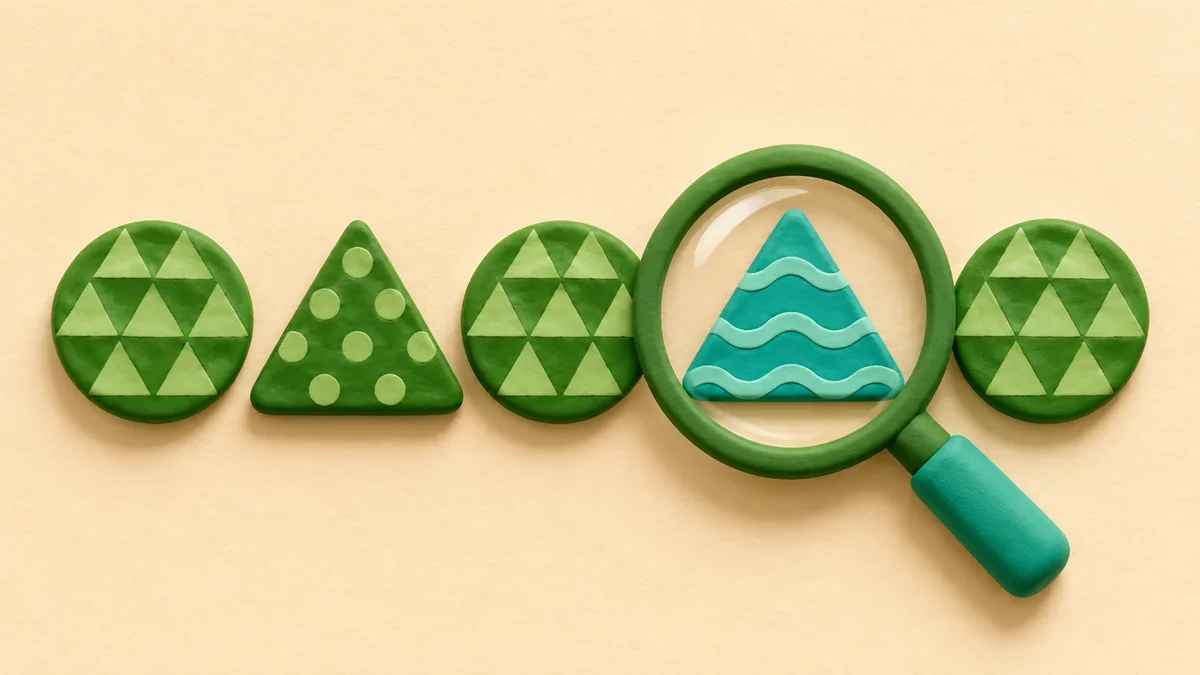
You see a few numbers or shapes and a rule seems obvious. The next step feels automatic. Then the puzzle reveals an answer you did not expect. Sometimes the mistake was arithmetic. Sometimes you found a pattern that fitted a few items without checking the whole task.
A useful practice question is 'What would show that my rule is wrong?' You are not trying to become suspicious of every simple answer. You are giving a plausible answer a small check before committing to it.
Describe the rule in words
Consider the numbers 3, 6 and 12. Doubling is a natural candidate. But those three numbers alone do not force every possible continuation. A short sequence can fit more than one invented rule. The wording, answer choices and other constraints help define what the puzzle expects.
Write your candidate clearly: 'Each value is twice the previous value.' That is easier to test than 'It goes up a lot.' Then apply it to each visible transition. If a task includes more rows, colours or positions, check whether your explanation accounts for those too.
Look for a useful counterexample
- State the candidate. Name the operation or relationship, including which objects it applies to.
- Check every shown case. Do not stop after the first two matches.
- Find a boundary. Ask what happens at the smallest value, a repeated item, a corner or another special position.
- Compare alternatives. If two rules fit, use the task's remaining information rather than pretending the ambiguity does not exist.
For a shape puzzle, your first guess might be 'The dark shape moves clockwise.' Check the shape's orientation as well as its position. If one changes while the other stays fixed, a rule that mentions only movement may be incomplete.
Do not add exceptions to rescue every guess
A tempting response to a failed rule is to make it more complicated: double the numbers, except sometimes add one, except after a red tile. A puzzle may genuinely use several conditions, but notice when your explanation is growing only to protect your first answer.
Try a fresh description using the complete example. You can compare two candidates on paper instead of keeping both in your head. One column can say what each rule predicts; another can show where that prediction agrees or disagrees with the board.
Practise explaining, not just selecting
After a Brainy Digits round, choose a task you understood and explain the rule without pointing to the answer. If your explanation relies on 'that one looks right,' identify the specific relationship you noticed.
Logic Challenge offers another setting for reasoning practice. Its catalog name describes a family of tasks, not a promise about general ability. A successful round tells you that your answers fitted those questions. To practise checking a real decision, apply the same explicit-rule check to that decision itself.
Use the method outside puzzles
Suppose you think a message needs no reply because it contains no question mark. Try to break that rule with an example: 'Please send the revised file today.' That sentence asks for action without ending in a question. Your rule needs to consider meaning, not only punctuation.
Today's quick win: write down one rule you are using in a puzzle or an everyday task. Give an example it handles correctly and look for one it would mishandle. If you find a failure, revise the rule before applying it again. A corrected explanation is a useful result even before the next score arrives.
It can help to ask another person for a different rule that fits the same small example. Compare predictions without turning the conversation into a contest. If both explanations fit everything provided, acknowledge the ambiguity instead of inventing certainty that the task has not supplied.