Generate more ideas by changing one constraint
Give an open-ended task a small boundary, explore it and then deliberately change the boundary.
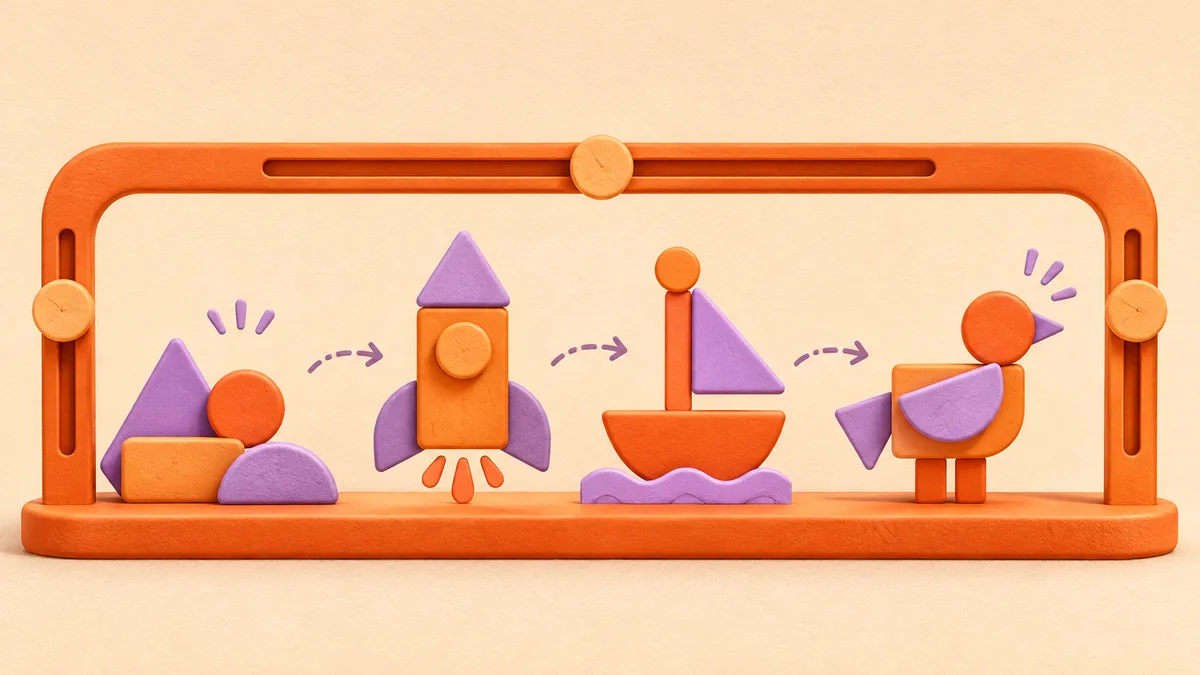
'Think of something creative' is a surprisingly difficult instruction to act on. What counts as something? What is it for? How will you know whether an idea is useful? A small constraint can give the exercise enough shape that you can start making choices.
Try designing a welcoming note for a shared room. You could begin with every possible style, material and message. Or you could choose one boundary: it must fit on a small card. The constraint gives you a specific problem to explore. Later, changing it creates a new question.
Choose the goal before the constraint
Write what the result should do. 'Help a visitor find the refreshments' is a goal. 'Use three colours' is a constraint. A colourful card that does not help the visitor has not met the goal, however interesting it looks.
Pick a harmless task for your first attempt: a simple invitation, a way to organise a shelf or a short story opening. Do not choose a problem whose consequences make experimentation risky. You want room to try, compare and discard ideas without pretending the first version must be used.
Run a small variation exercise
- Set one boundary. Use only one material, keep the message very short or design for one particular location.
- Make three distinct candidates. Change the approach, not merely the colour of the same idea.
- Explain each candidate. Say how it serves the goal and where it might fail.
- Change the boundary. Remove the first constraint or replace it with another, then make one more candidate.
For the refreshments note, three candidates could be a clear arrow, a tiny map and a picture of the table. Now change the boundary: the note must work from across the room. Some details disappear, and the best candidate may change. You have discovered something about the communication task, not simply produced more decoration.
Separate making from choosing
During the first few minutes, write down possibilities without polishing each one. Afterwards, inspect them against the goal. This is a suggested way to organise the exercise, not a claim that judgement must always wait until a separate stage. In a real project, you may move between both jobs repeatedly.
Keep at least one reason for rejecting an idea. 'Too small to read from the doorway' is a useful constraint for the next attempt. 'Not creative enough' is difficult to act on. Describe the problem in terms someone else could check.
Use games as prompts, not automatic proof
A round of Letter Wheel can suggest a playful word constraint. A visual puzzle might suggest working with a limited set of shapes. Keep your open-ended extension separate from the game's scoring rules, and do not assume the game measures creativity as a whole.
You could make a short invitation using only familiar words from a chosen topic, then rewrite it for a different audience. The important comparison is whether the new version communicates better to that audience. Counted words or game points cannot answer that question for you.
Know when to remove the boundary
A constraint is a tool, not a tradition you must preserve. If it prevents the goal from being met, explain why and change it. You may discover that the most useful idea appears when you abandon an arbitrary limitation altogether.
Today's quick win: choose one small design or writing task, set one boundary and make three genuinely different candidates. Change that boundary once. Keep the candidate that best serves the goal, and record the reason you chose it.
If someone else reviews your candidates, give them the goal before asking which one they prefer. Ask what they could actually understand or do with each version. That feedback concerns the design's purpose, rather than whether their taste matches yours.