
Solve a crossing word to get a letter that narrows the answers to a difficult clue.
Crossword Puzzles: How Beginners Solve More Clues
Stuck on crossword puzzles? Use crossing letters, check clue forms, revise guesses, and choose help for unfamiliar answers.
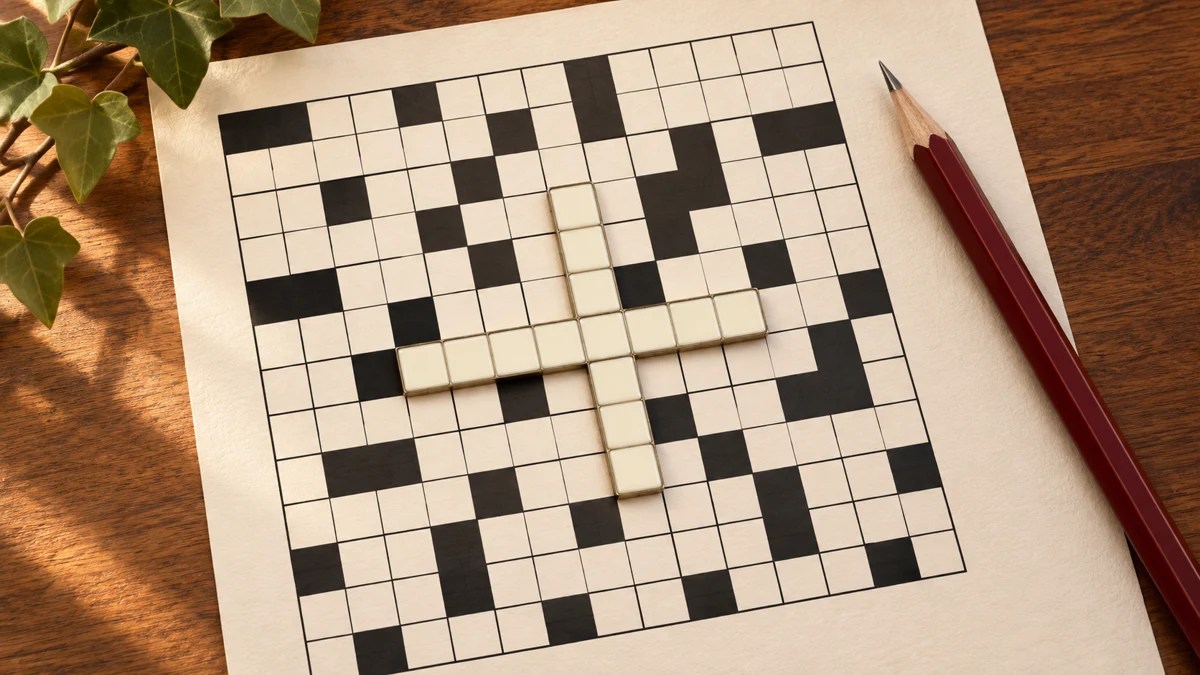
In crossword puzzles, solve a word that crosses the clue you're stuck on. Its letters give you something to work with when several answers fit the meaning and the number of spaces. Leave the difficult clue for a moment and look for a crossing answer you know.
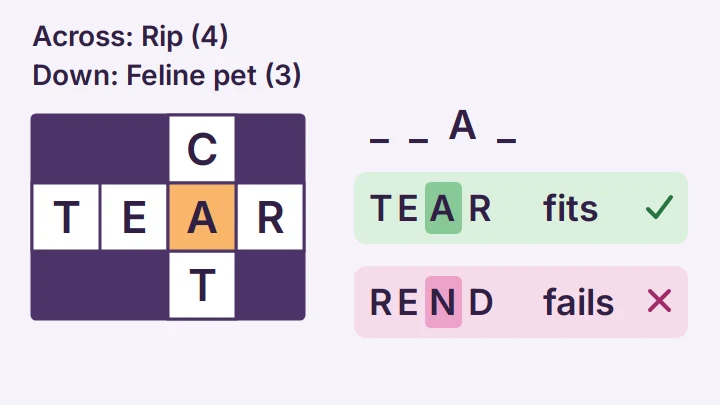
Take the clue “Rip” with four spaces. TEAR and REND both fit. The crossing clue “Feline pet” gives CAT, with its A in the third space of “Rip.” The pattern becomes _ _ A _, so TEAR fits and REND's N clashes with the A.
The clue's form matters too. “Feline pets” needs CATS, and “Made a sketch” needs DREW. Before entering a word, check whether the clue asks for one thing or several, and whether the action already happened.
| Example clue | Possible answer | Detail to check |
|---|---|---|
| Feline pet | CAT | One animal |
| Feline pets | CATS | More than one animal |
| Make a sketch | DRAW | The action |
| Made a sketch | DREW | The action already happened |
When an answer blocks its neighbours
A word can match a clue and still be a guess. If a crossing answer becomes impossible, review both words before filling more squares around them. Check the meaning and the number of letters, then compare the shared square. Changing an uncertain answer can give the crossing word room to fit.
Keep guesses easy to change. On paper, a light pencil mark can separate a possible answer from one supported by crossings. On a screen, keep track of which entry was uncertain. A letter from that guess still needs checking when another word depends on it.
| What supports the answer? | How to treat it |
|---|---|
| Only the right number of letters | Keep looking for a match to the clue |
| The meaning and length fit | Try it, but keep it easy to change |
| The clue and crossing letters fit | Leave it while working on nearby entries |
| A crossing word clashes with it | Review both answers and the shared letter |
There is no need to solve the clues in order. Scan for a definition that brings a word to mind, even if it appears halfway down the list. Short entries are worth checking, though a longer word with an obvious definition can also give you a start.
In Cleverini's Crossword, tapping a square shows its clue, and tapping it again switches between Across and Down. The two clue lists also let you move directly to another entry. After filling a word, the entries that cross it have new letters to use, so those are worth another look.
 Cleverini's Crossword
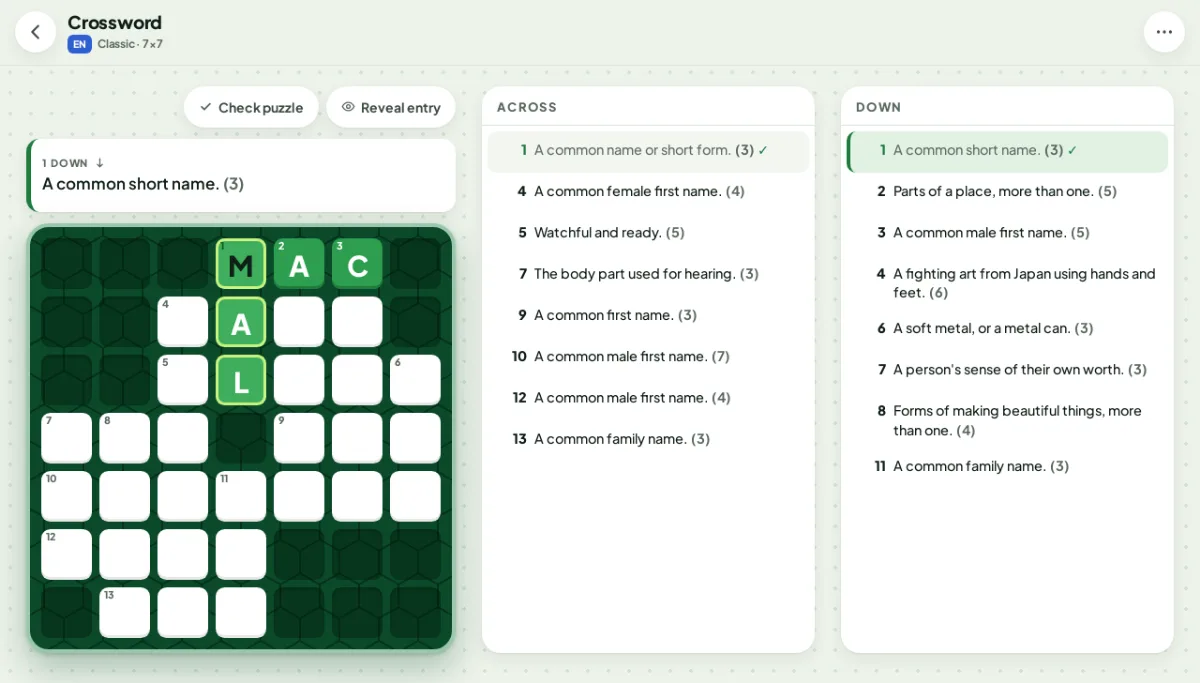 The Across and Down lists let you choose a crossing clue when the selected answer is difficult.
Choose help for the clue in front of you
Cleverini offers a compact 7×7 grid and a larger 9×9 grid, with definition clues in English, Spanish, German and French. The smaller grid leaves fewer squares to fill. A familiar language lets you focus on matching words to clues, while another language adds vocabulary and spelling to the task.
Correct words can turn green, and that help can be switched off. Leaving it on gives you feedback as you fill words. With it off, you can spend more time comparing an answer with its crossings before getting confirmation. Check and Reveal are in the ⋯ menu.
| Situation | What to try |
|---|---|
| An answer fits the meaning but clashes with a crossing | Recheck the clues for both words |
| Immediate confirmation would help | Leave the green correct-word help on |
| A word remains unfamiliar | Use Reveal, then read the clue with the answer visible |
| You want more time to solve before getting feedback | Switch the green help off |
After revealing an unfamiliar word
A revealed answer gives you a chance to connect the word with its clue. Read the definition again with the answer visible, then check how the word fills the spaces. If a letter differs from your guess, compare the spelling before moving to the crossing clue.
An unfamiliar meaning may need a dictionary. Look up the meaning used in the clue and check that it matches the answer. A short word note can keep that meaning handy after the puzzle, especially when a familiar word was used in a way you hadn't met before.
| Part of a word note | What to keep |
|---|---|
| Answer | The word with its correct spelling |
| Clue | The definition used in the puzzle |
| Meaning | A short explanation in familiar words |
| Sentence | A sentence that uses that meaning |
When returning to the grid after using help, start with an unfinished word that crosses the answer you revealed. It now has another letter to work with. Check that letter's position, read the clue again, and try a word that fits both.
More from the blog

Tip of the Tongue: Why You Can't Find the Word
Why a tip of the tongue word stays missing when its meaning is clear, and how descriptions, sound clues and recall practice fit different gaps.

Word Games for Adults: Free Picks for Every Player
Find free word games for adults beyond one daily puzzle, with guessing games, letter wheels, crosswords, and optional word-recall practice.

